Written by the EasyDone team. Last checked 25 November 2026.
The short answer: in Western Australia you need a safe work method statement (SWMS) before any high risk construction work starts. It names the high risk work, the hazards, the controls and how you'll check them. Your crew must understand it, the work must follow it, and you keep it until the job is done (two years if there's a notifiable incident).1 Grab our free fillable template below, or skip the paper: in EasyDone Work your crew reads and signs the SWMS on their phones every morning.
Free download: fillable WA SWMS template (PDF). It has WorkSafe WA's 18 high risk construction work boxes, a hazard table with the risk before and after controls, equipment checks and a sign-on register. Fill it in on your computer, or print the blank one. It's a template to help you prepare your SWMS, not legal advice.
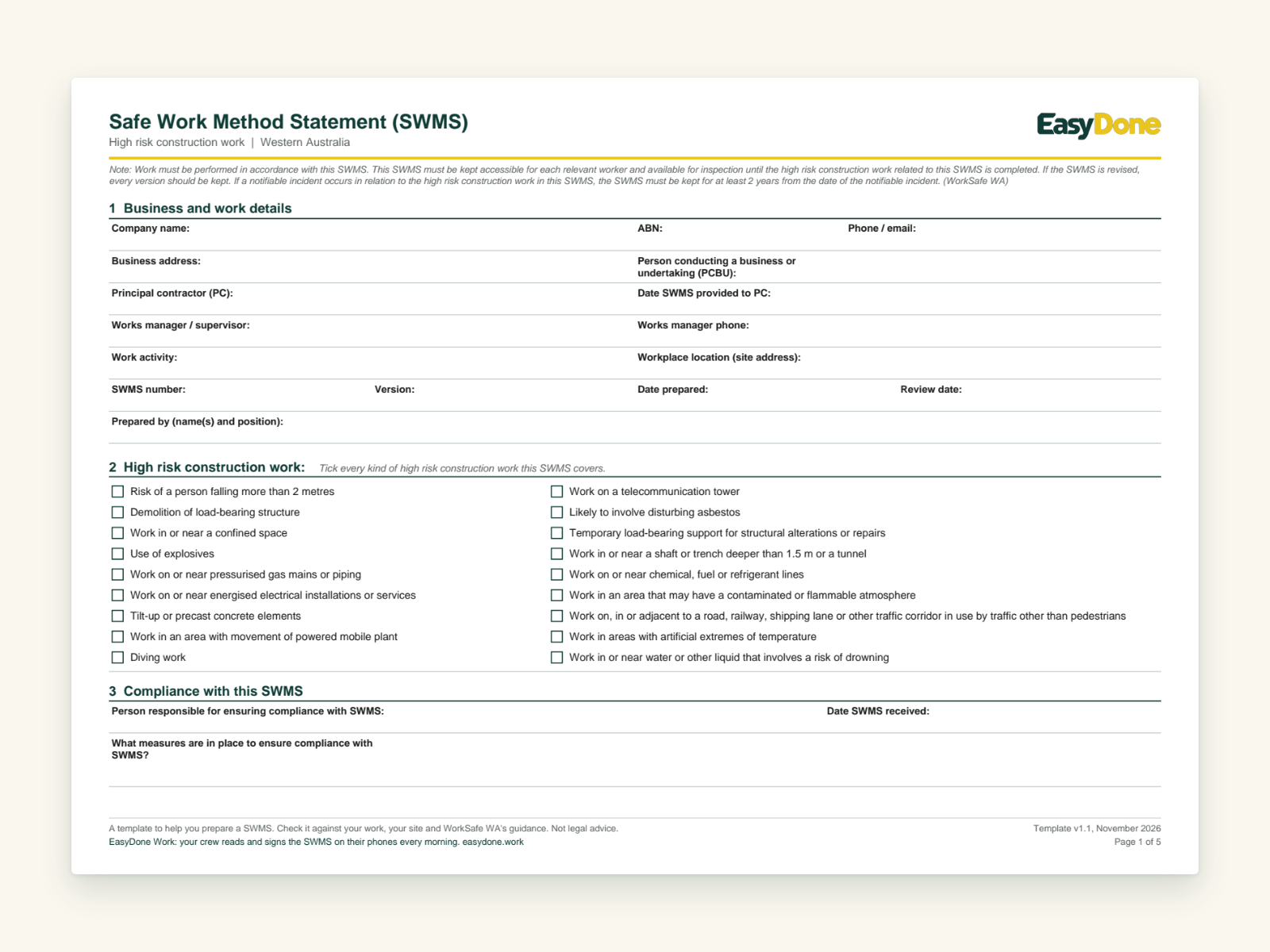
See what EasyDone Work prints: a sample SWMS printed from EasyDone Work (PDF, 7 pages), made for a fictional plumbing business.
Your SWMS in EasyDone Work, in four screens
Paper SWMS fail in the same places: the crew signs on day one and never sees it again, nobody prints the new revision, and the only copy is in the ute when the inspector is at the gate. Here's the same SWMS in EasyDone Work. These are real screens; the business and job are a fictional example.
1. Build it once, the way WorkSafe WA's form asks
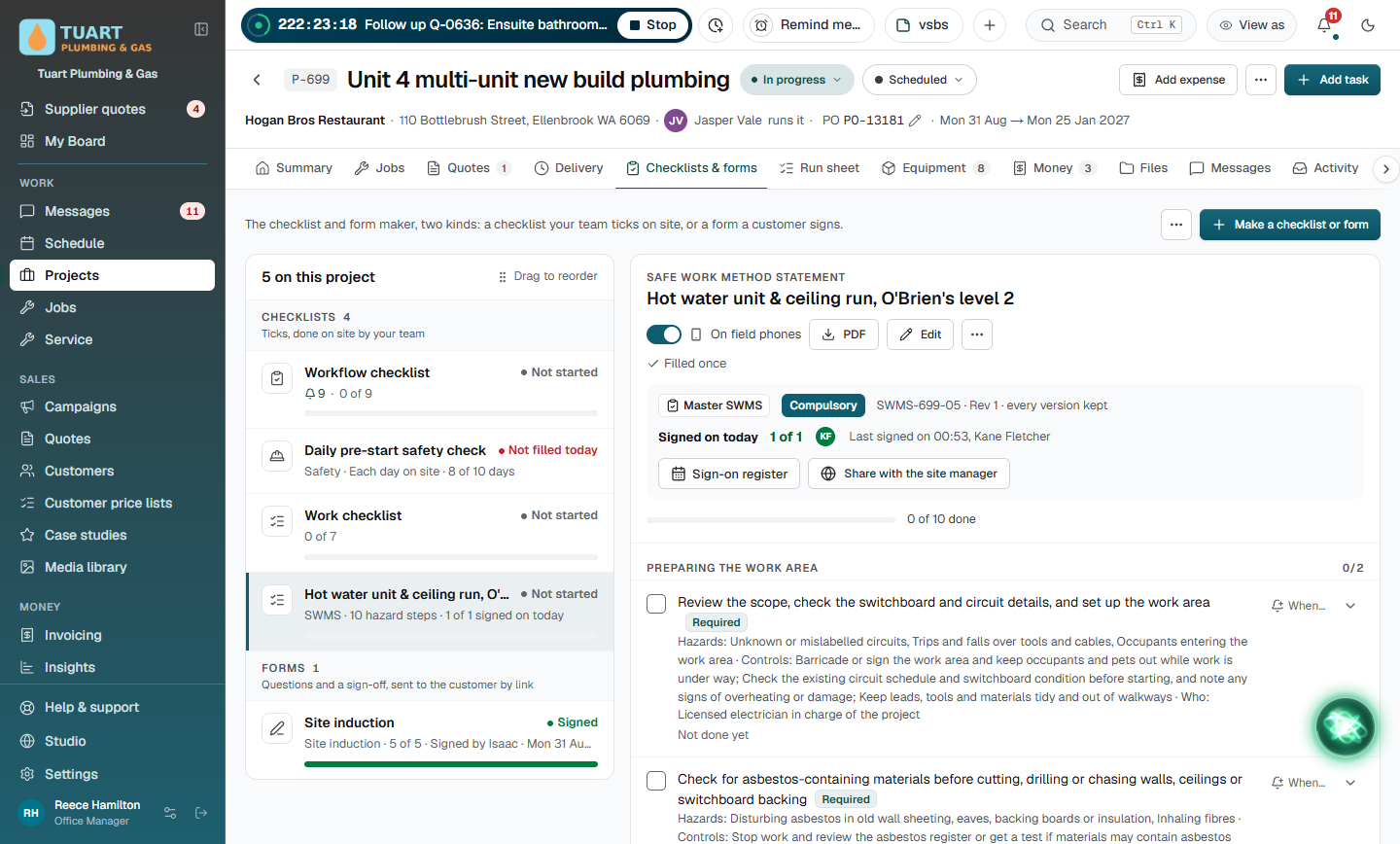
The SWMS maker sits in the checklist maker and follows WorkSafe WA's form. You tick which of the 18 kinds of high risk construction work it covers, write each step's hazards and controls, rate the risk before and after from your own risk matrix, and add equipment checks.3 New businesses start with a ready-made SWMS template, and you can make it compulsory on high risk jobs.3
2. The crew signs on each morning, on their phone
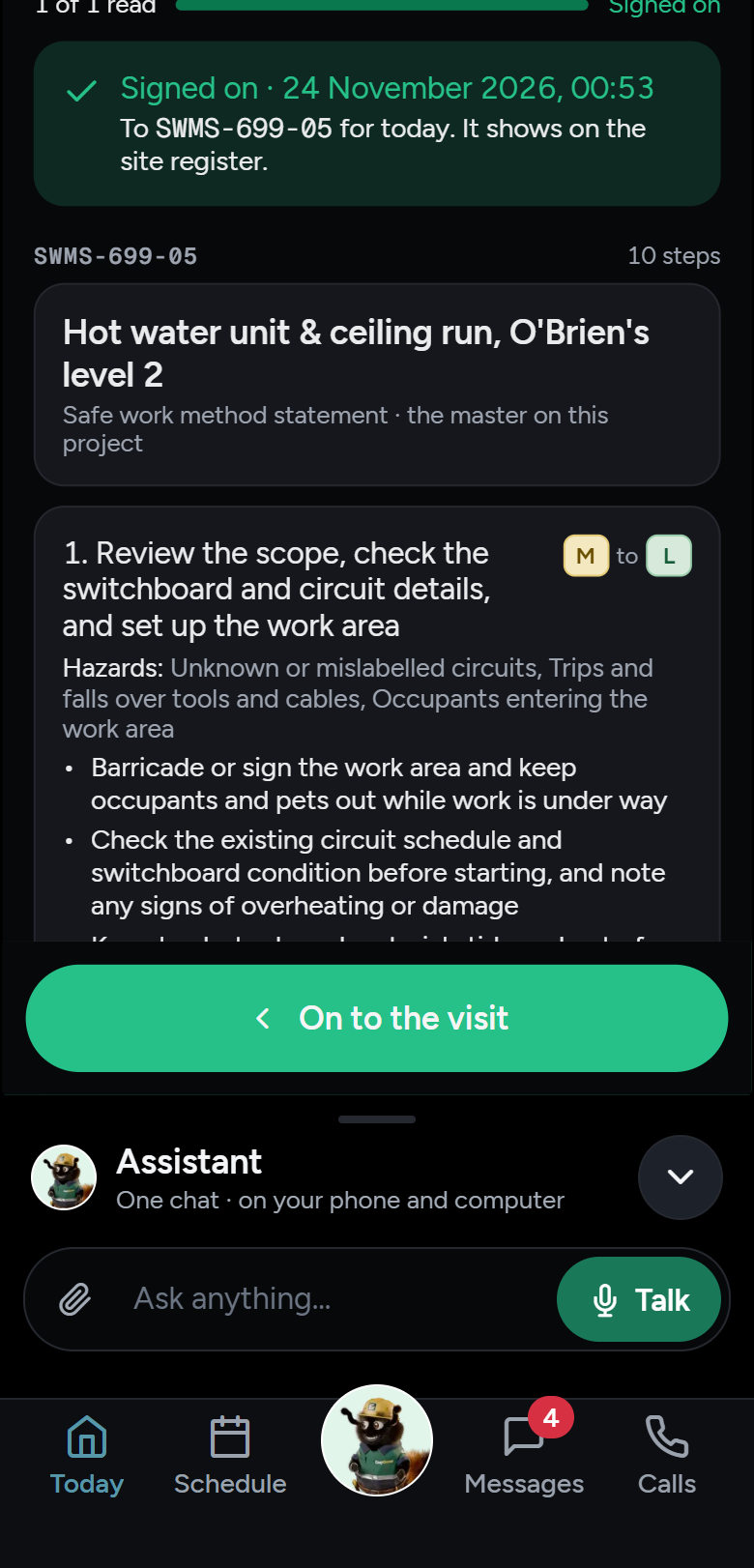
Everyone booked on the project reads, ticks and finger-signs the project's master SWMS on their phone before their first job there each day, and the office sees how many have signed on today.3
3. Read it, tick it, sign it
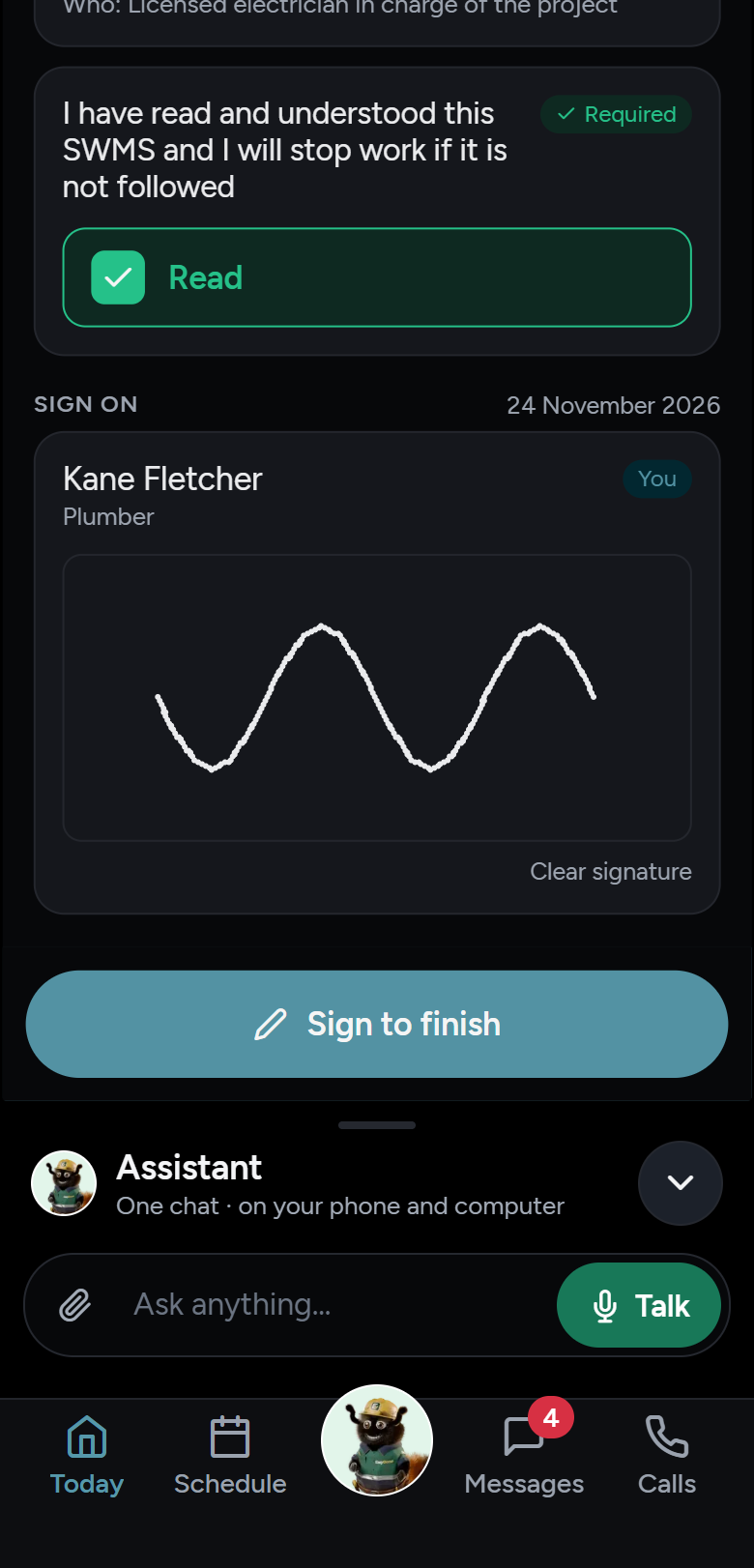
4. Print it for the principal contractor
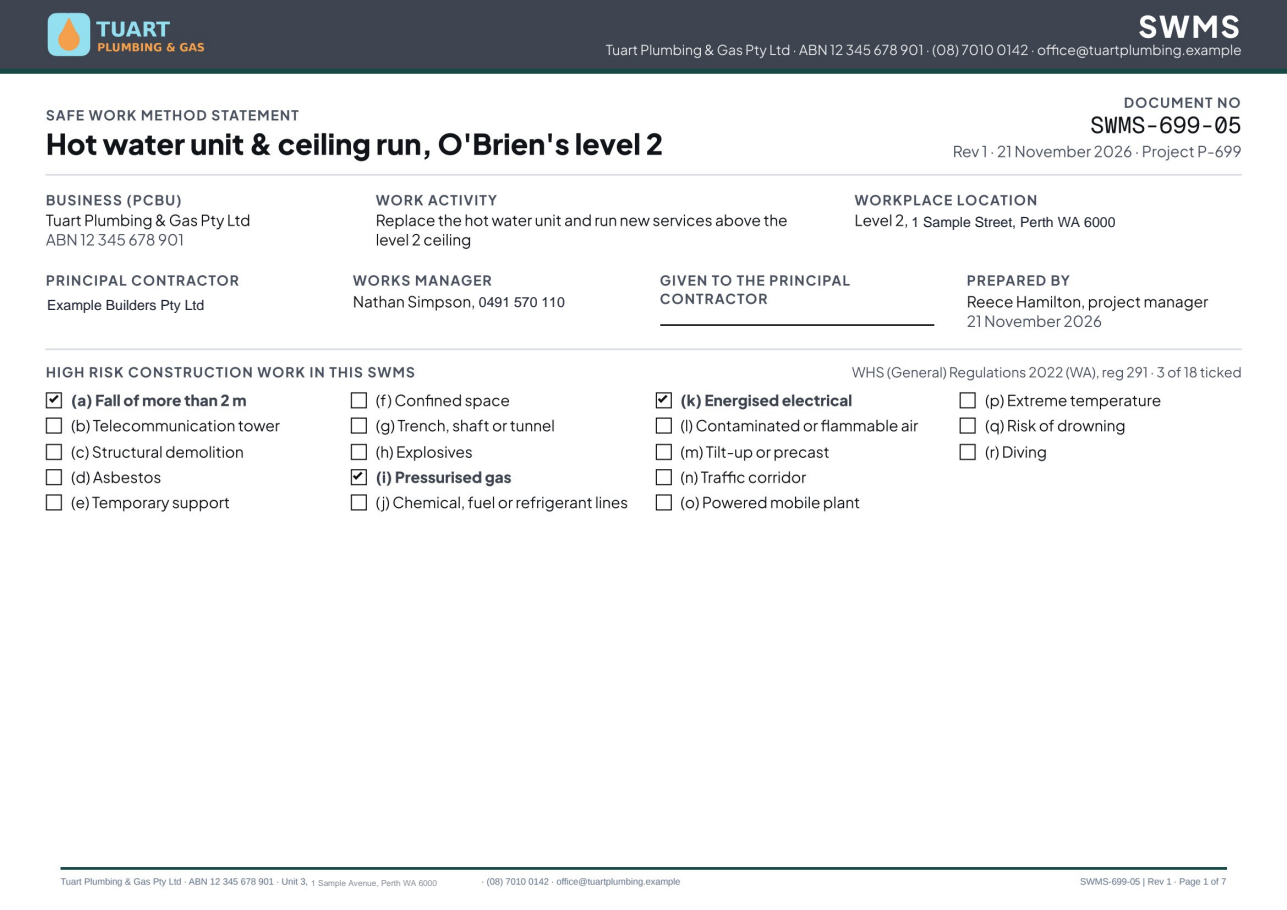
It prints on A4 landscape with the sign-on register, ready to hand to the principal contractor: see a sample printout (PDF).3 If the SWMS changes after people have signed on, EasyDone makes a new revision, so every version is kept. After a notifiable incident you can lock it so it can't be changed, archived or deleted for two years, while sign-ons still go on.3
Paper SWMS or SWMS in EasyDone?
| Paper or Word SWMS | SWMS in EasyDone Work | |
|---|---|---|
| Signing on | Once, usually on day one | Every morning, by each person, on their phone |
| A change to the work | A new revision someone has to print and re-brief | A new revision, every version kept |
| Who has signed today? | Flick through the pages | The office sees it on the project |
| A copy for the principal contractor | Scan or photocopy | Print to A4 with the sign-on register |
| After a notifiable incident | Find the right version and keep it | Lock it for two years; sign-ons go on |
Two honest limits: EasyDone's SWMS follows WA law today (other states are still to come), and it's built on our own reading of the rules, so it isn't legal advice.3 You still decide what goes in your SWMS for each site.
See it on a real job: book a demo, or try EasyDone free for 7 days. More on checklists and forms.
What WA law asks of a SWMS
The rest of this guide is drawn from WorkSafe WA's own information sheet on SWMS for high risk construction work, read on 24 November 2026. It is general information, not legal advice.
When do you need a SWMS in WA?
The Work Health and Safety (General) Regulations 2022 require a SWMS to be prepared before high risk construction work begins.1 WorkSafe WA's template lists 18 kinds of high risk construction work, including:1
- a risk of a person falling more than 2 metres
- demolition of a load-bearing structure, and work likely to disturb asbestos
- temporary support for structural alterations or repairs
- work in or near a confined space, or a shaft or trench deeper than 1.5 metres, or a tunnel
- work on or near pressurised gas mains or piping, or chemical, fuel or refrigerant lines
- work on or near energised electrical installations or services
- tilt-up or precast concrete
- work next to a road, railway or other traffic corridor in use, or where powered mobile plant is moving
- work in a contaminated or flammable atmosphere, artificial extremes of temperature, or near water with a risk of drowning
- telecommunication towers, explosives and diving work
A SWMS is not required for work of a minor nature.1 For all other construction work you still have to manage the risks, but a SWMS isn't the required document.1
What must a SWMS include?
WorkSafe WA says a SWMS must:1
- identify the work that is high risk construction work
- specify the hazards relating to that work and the risks to health and safety
- describe the measures to control the risks
- describe how those control measures will be implemented, monitored and reviewed
It should be short and specific. WorkSafe WA warns that a lengthy, overly detailed SWMS can be hard to understand, apply, monitor or review, and it must be easy for your workers to understand, including workers from non-English speaking backgrounds. Pictures or diagrams can help.1 Hazards like noise and manual tasks still need managing, but they don't need to be in the SWMS.1
Who prepares it, and who gets a copy?
The person carrying out the high risk work is best placed to prepare the SWMS, consulting the workers who will do the work, and the health and safety representative if there is one.1 Usually that's the business for its own workers, or the subcontractor for their workers and themselves.
On a construction project (5 or more people working at the same time on site), the principal contractor must be given a copy of the SWMS before the high risk work starts.1
Can you use a generic SWMS?
Only once it has been reviewed and changed for the actual workplace. A generic SWMS used at different sites may not meet the regulations unless it reflects that site, its work environment and the workers doing the job.1 One SWMS can cover several high risk activities on the same job, or you can write one per activity.1
On site: follow it, stop if it isn't followed
High risk construction work must be done in line with the SWMS. If it isn't, the work must stop immediately or as soon as it's safe, the SWMS should be reviewed, and work can't resume until it can be done in line with the SWMS.1
WorkSafe WA recommends briefing each team member before work starts and reviewing the controls:1
- before a change to the work, the system of work or the location
- when a new hazard is identified
- when new information about a hazard becomes available
- when a notifiable incident occurs
- when the controls aren't working or the SWMS isn't being followed
How long do you keep a SWMS?
Keep it until the high risk work it covers is finished. If a notifiable incident occurs in connection with that work, keep it for at least two years from the date of the incident.1 It should be kept on site or somewhere it can be brought to site quickly, it can be kept electronically, and if you revise it, every version should be kept.1
Free SWMS templates for WA
- Ours: the fillable WA SWMS template (PDF) above, with a sign-on register for your crew.
- WorkSafe WA's: a free SWMS template in Word, with a filled-in example (a bricklaying job) in its information sheet, on WorkSafe WA's SWMS page.2
Whichever you use, fill it in for the actual site and the actual crew, not once for every job.
A quick SWMS check for every high risk job
- Is any of the work on WorkSafe WA's high risk construction list?
- SWMS prepared before the work starts, with the crew who'll do it?
- The high risk work, hazards, controls and how you'll monitor them all in there, in words the crew understands?
- Written for this site, not copied from the last one?
- Principal contractor given a copy, if it's a construction project?
- Crew briefed, and do they know work stops if the SWMS isn't followed?
- Every revision kept, and the SWMS kept until the work is done?