In WA, an electrical contractor owes the customer an Electrical Safety Certificate within 28 days of finishing any installing work.1 The contractor also owes the network operator (usually Western Power or Horizon Power) a Notice of Completion within three days, with no exceptions, lodged through Building and Energy's eNotice system.24 That's two forms with two deadlines, going to two different people, and mixing them up is the quickest way to a cranky customer or a call from the regulator.
Below is what the rules say, what the form asks for and how to stop either one slipping on a busy week.
What is an Electrical Safety Certificate in WA?
The Electrical Safety Certificate (ESC) is the certificate of compliance required by Regulation 52B of the Electricity (Licensing) Regulations 1991.1 On the ESC, the electrician who did the work certifies three things: the work was completed, it was checked and tested, and at the time of testing it met the regulations and was safe.1
Only a licensed electrical contractor can issue one. Building and Energy tells customers the ESC is their assurance that a licensed contractor did the work, that it's safe and that it complies with the safety standards that apply.1 So your customer has been told to expect it.
How is the ESC different from the Notice of Completion?
The Notice of Completion (NOC) goes to the network operator, and the ESC goes to the customer. The NOC is due three days after the work is complete, with no exceptions, and nominees can lodge it online through Building and Energy's eNotice system.2 The customer's copy of the ESC is due within 28 days.1
| Notice of Completion | Electrical Safety Certificate | |
|---|---|---|
| Goes to | The network operator, usually Western Power or Horizon Power (Building and Energy where there is none)4 | The person the work was done for1 |
| Deadline | 3 days after completion2 | 28 days after completion1 |
| How | Online through eNotice2 | A copy given to the customer1 |
| If it's late | Contact Building and Energy so the delay is noted and recorded2 | The customer is told to chase you, then the network operator1 |
The three day clock is the one that bites. Finish late on a Friday and the paperwork has a whole weekend sitting between the van and the office.
Which jobs need an Electrical Safety Certificate?
An ESC is required for all electrical installing work. Building and Energy's customer brochure names two exclusions: maintenance work, and like for like replacement of electrical equipment.1 Everything else gets a certificate.
Three situations trip people up:
- Subcontracting. If you subcontract to another electrical contractor, the subcontractor gives the ESC to the person who asked for the work to be done.2 Settle who that person is before the job starts.
- Solar. The Clean Energy Regulator requires an NOC and an ESC before small scale technology certificates (STCs) are created.2 No paperwork, no STCs.
- Mixed visits. The brochure's only exclusions are maintenance and like for like replacement.1 When a visit is part maintenance and part something new, ring Building and Energy and ask which side the new bit falls on, rather than guessing your way out of a certificate.
What goes on form E052?
The WA Electrical Safety Certificate is form E052, and it asks for five blocks of detail:1
- Installation details. The owner or occupier's name, the address, the meter number, whether it's a new installation or an alteration or addition, and the date of completion.
- Details of the work. A general description, plus the number or rating in each category: lights, socket outlets, cooking appliances, water heaters, motors, air conditioners, RCDs and smoke alarms.
- RCD protection. Whether all socket outlet and lighting final subcircuits are protected by at least two RCDs and, if not, which circuits aren't.
- Defects observed. For alterations and additions only.
- Certification. The name, signature and EW licence number of the electrician who did the work, and the contractor's EC licence number, business name, address and phone number.
Block two is where the chasing happens. If eleven downlights went in and the office writes ten, somebody's ringing the apprentice or driving back out.
How do you get both done on every installing job?
Capture everything on site, and treat the two deadlines as separate jobs with separate ticks.
- Call it before you start. Decide whether the job is installing work, maintenance or like for like replacement, and note it on the job. That decides whether an ESC is owed at all.1
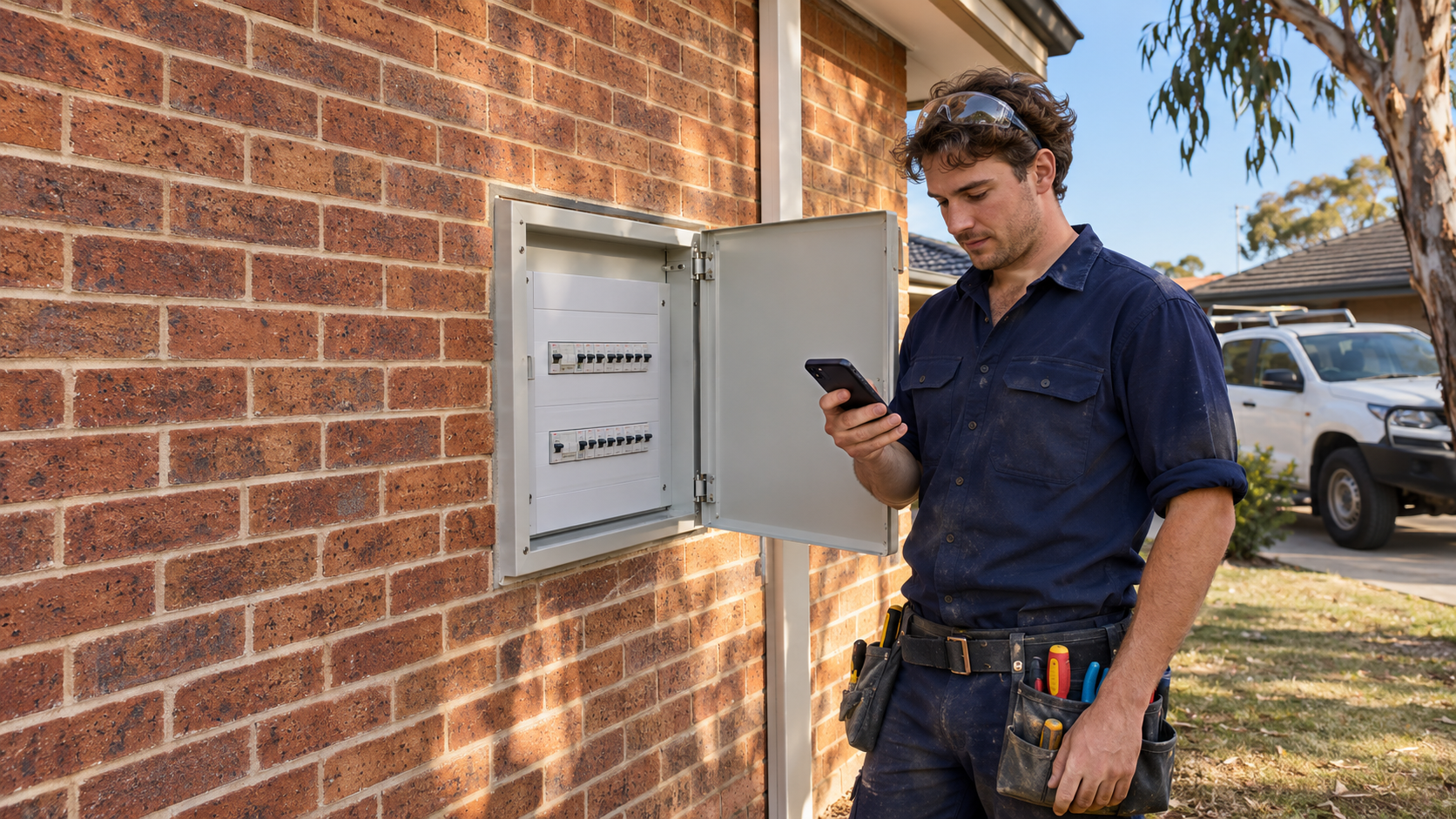
- Count on site, not at the bench. Record the number or rating in every E052 category while you're standing in front of the work. A photo of the board backs up the RCD count.
- Answer the RCD question properly. If the socket outlet and lighting final subcircuits aren't all covered by at least two RCDs, list the circuits that aren't.1
- Write up defects on alterations. On an alteration or addition, note what you saw while it's fresh. That box is only for those jobs.1
- Lodge the NOC by day three. Lodge through eNotice and keep the reference with the job.2 If you miss it, ring Building and Energy rather than hoping nobody notices.2
- Send the ESC with the invoice. You've got 28 days.1 Sending the certificate with the invoice means it goes out with something you'd never forget to send.
Where do electricians get caught out?
Every sparky knows the forms exist, so a missed certificate is usually down to how the paperwork moves, not what anyone knows. These are common ways a form slips through:
- One tick for two forms. "Paperwork done" on the job, when only the NOC went in.
- Counts from memory. The office fills in E052 from the quote, not from what actually went in the ceiling.
- The Friday finish. The job wraps late, the notes sit in the van over the weekend, and Monday starts with a scramble to get the NOC in.
- The subby gap. Head contractor and subcontractor each assume the other one is sending the ESC.
- Solar held up. The STCs can't be created until both forms exist, so one late form holds up the whole system.2
Do electrical safety certificates expire?
An Electrical Safety Certificate doesn't run out, because it speaks to the work as it was when it was tested. The electrician certifies that, at the time of testing, the work met the requirements.1 Building and Energy strongly recommends customers keep it somewhere safe with their other important records.1 Later work on the same installation is new work with its own paperwork.
What happens if the customer never gets one?
A customer who never gets an ESC is told to contact the electrical contractor first. If the certificate still doesn't turn up, they're told to notify the network operator, which in most cases is Western Power on 13 13 51 or Horizon Power on 13 23 51.1 That's a conversation you want to have with your customer, not one Western Power starts for you.
How does EasyDone keep the certificate details on the job?
In EasyDone, checklists sit on the job, and the electrician fills them in on the phone while they're on site, with photos attached.3 The office sees the answers as soon as they're saved, so nobody is decoding a scrap of paper on Monday morning.3
Set up one checklist that mirrors form E052 and add it to your installing jobs. Give it a line for installing work or maintenance, the count for each category, the RCD answer and the circuits that miss out, defects on alterations, the NOC reference, and the date the ESC went to the customer. When the office sits down to fill in the form, every number is already there, with a photo of the board behind it.
One honest limit: EasyDone doesn't lodge the NOC through eNotice or fill in form E052 for you. Its job is making sure everything both forms need is captured on site and in front of the office.
What should you do this week?
Pull up last month's installing jobs and check each one has an NOC reference and a date the ESC went to the customer. Any certificate that hasn't gone out, send it today; anything still inside the 28 days is still on time.1 Then, if you want those counts captured on site from now on, see how EasyDone works and picture your E052 checklist sitting on every installing job.