Written by the EasyDone team. Last checked 10 October 2026.
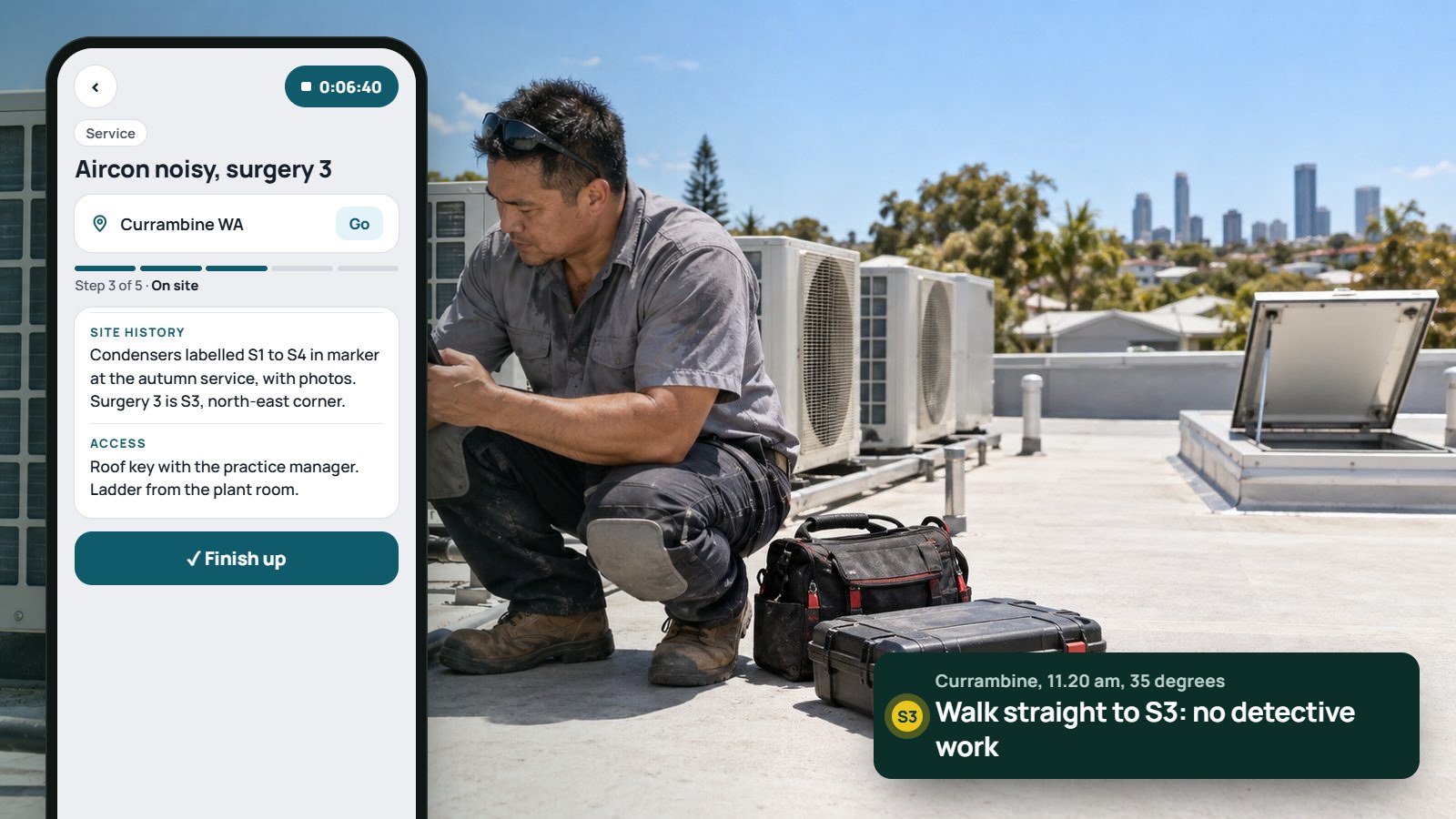
It's 11.20 on the first proper hot day of spring and Reuben Achterberg is on the roof of a dental practice in Currambine. It's already thirty-five up here. In front of him are four condensers, identical, same brand, same age, same faded stickers. The job on his phone says "aircon noisy, surgery 3".
Which one is surgery 3?
Downstairs, the practice manager doesn't know. The dentist has patients from two o'clock and wants it sorted. The property manager who approves anything over a callout is in a meeting in West Perth. And back in Clarkson, Kirsty Vance has nine more techs out and the phones going like it's January.
Reuben will work it out. He always does. But he's going to spend forty minutes on a hot roof doing detective work nobody's paying for.
What's really going on?
Vance Cooling & Heating has eleven techs, two apprentices, a busy office and a summer coming that'll double the callouts. Kirsty isn't short of work. She's short of detail at the right moment.
HVAC is different from most trades because you service the same equipment, over and over, for years. Every visit leaves a trail, and the next tech either picks it up or starts from scratch on a hot roof. On that Currambine job there are five people: the practice manager who reported it, the dentist who's annoyed, the property manager who pays, Reuben who's actually up there, and whoever goes back next time.
HVAC visits go sideways at six handovers. Here's how to nail each one.
1. Before the booking: which unit, where, and why?
"Aircon" isn't a job description. A site with four systems needs four separate labels, and the booking should say which one the visit is about, where it lives and what the customer said, in their words.
Ask the questions that save a roof climb. Which room? Which wall unit? Is it noise, no cooling, water leaking or an error code? If the customer can text a photo of the indoor unit's sticker, that's gold.
Keep the customer's report as a report. "Surgery 3 noisy" is a symptom. The tech decides what it is. Nobody in the office should be turning it into a diagnosis, and neither should any software.
And sort the access. Roof key, ladder access, the building manager's number, any time windows. A tech who has to wait forty minutes for a key is the most expensive cuppa you'll buy all week.
2. Is this the right tech for this job?
An empty slot in the diary isn't the same as the right person. Refrigerant work in Australia needs the right licence: the Australian Refrigeration Council spells out who needs a refrigerant handling licence and for what.1 An apprentice can do plenty, but not everything, and the booking should reflect that before the van leaves.
Here's a habit worth stealing: every afternoon, the office runs through tomorrow's jobs with three questions. Is the equipment identified? Is access sorted? Is the right person booked for what's likely to be needed? Anything that's a no gets a name against it before knock-off.
3. What goes in the service note?
Which unit, what you found, what you did, what you used and what's still open. In that order, every time.
"Serviced" is useless. "Condenser 3 of 4 (north-east corner, labelled S3 in marker), fan motor bearing noisy, unit cooling to spec, recommend fan motor replacement, customer advised" is gold. The next tech can walk straight to it.
Keep your measurements the way the qualified tech records them, and keep three kinds of statement separate: what was observed, what's suspected and what's confirmed. A report that sounds more certain than the tech was is a problem waiting to happen.
Photos beat paragraphs. The data plate, the fault, the label you stuck on the unit. And keep them about the equipment. The OAIC is clear that photos of identifiable people raise privacy issues,2 so leave the patients in the waiting room out of the shot.
4. Where do refrigerant records and safety info fit?
In their proper place. ARC's permit condition checks look at refrigerant, equipment and staff licence records,3 and those records need to be kept the way your authorisation requires. A service note isn't a refrigerant register, so don't pretend it is.
What the job record can do is make sure nothing falls through the cracks: a step that says "refrigerant record updated", with a name against it.
Same with chemicals. Safe Work Australia says the safety data sheet is the source for hazard and handling information,4 so the crew should be going to the SDS, not to a summary someone wrote once.
5. The return visit: what has to happen first?
This is where HVAC businesses bleed money. A return visit booked on hope is a wasted drive up the Mitchell.
Every return needs three things on it: why it's needed, what has to happen first (the part arrives, the property manager approves, the roof key is available) and who's confirming that's happened. Don't send the tech back because a supplier email said "should be Thursday".
And check who says yes to the money. On a commercial site, the person who rang about the noise is rarely the person who approves a fan motor. Get the quote to the right inbox the first time.
6. What does the customer actually get?
A plain account of what was done and what's next. Keep "recommended" separate from "approved and done". The ACCC is clear that services come with guarantees of due care and skill,5 so a report shouldn't use breezy language to cover a unit that couldn't be checked.
If there's a quote or an invoice going with it, check the document and the recipient before it goes, every time.
How Kirsty runs that Currambine job in EasyDone
Yeah, we make EasyDone, so we're biased. Here's why we reckon it was built for exactly this kind of hot morning.
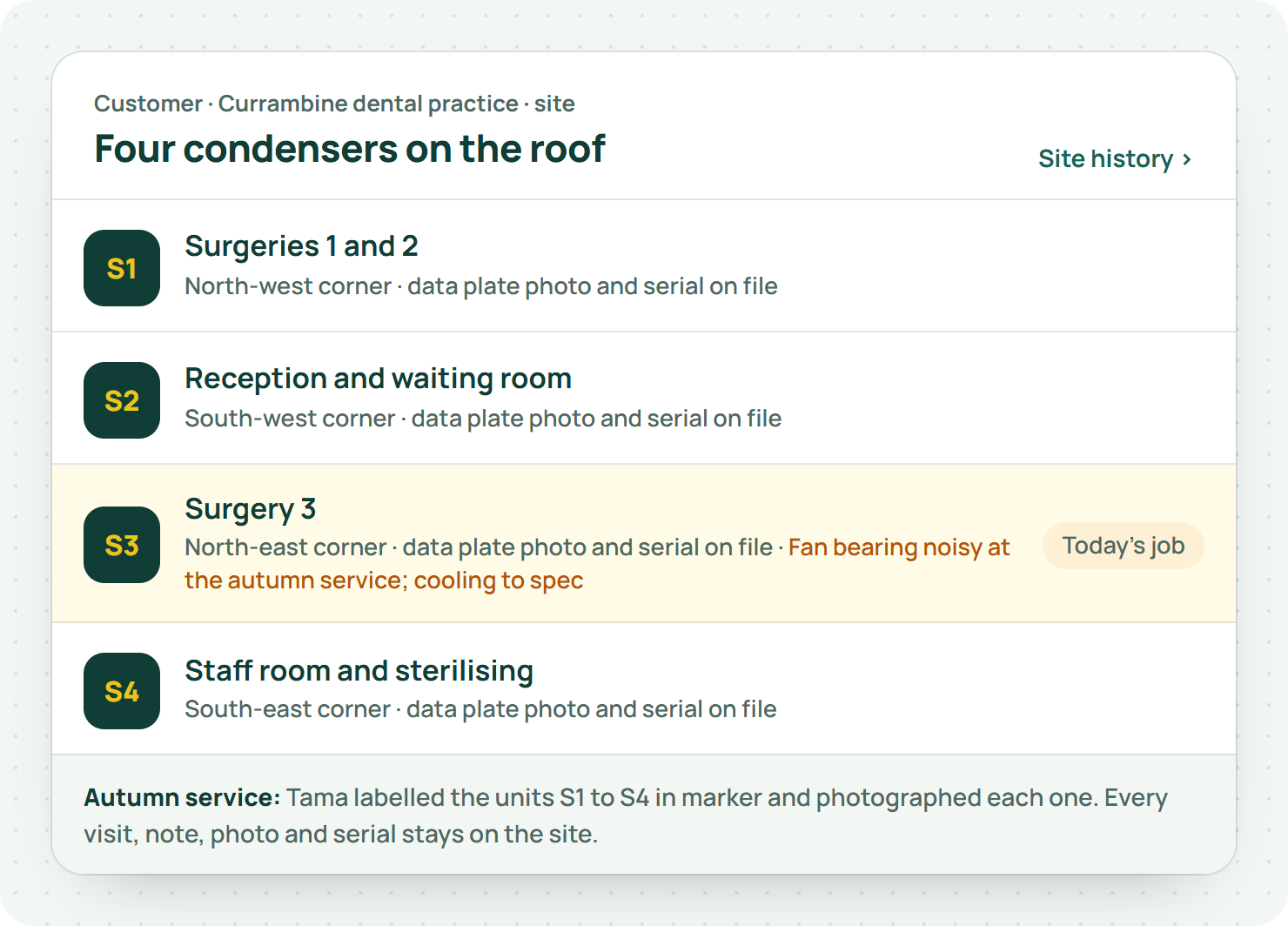
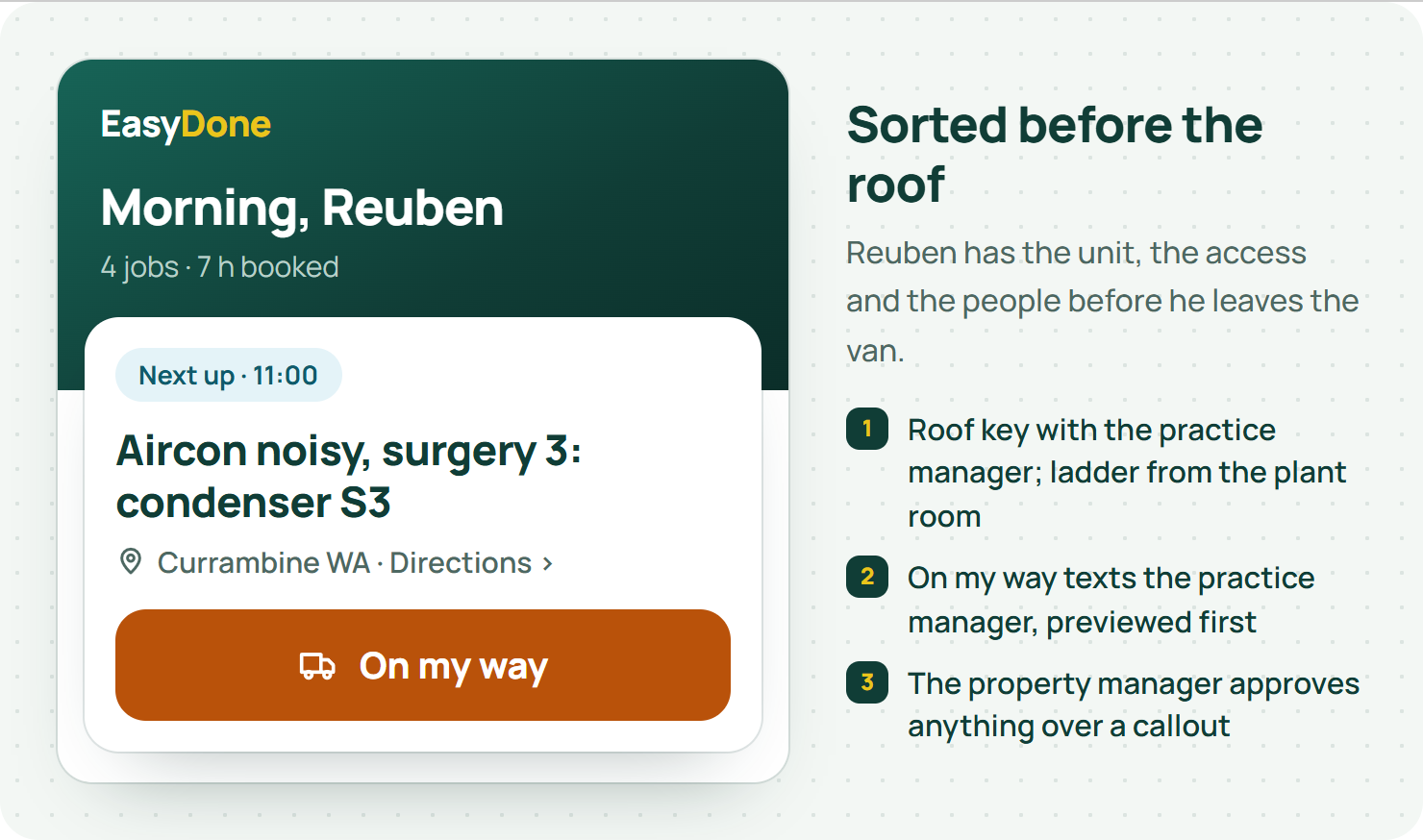
The practice is a customer with its site underneath, and the site has its history: every visit, every note, every photo and the serial numbers captured on site last time.6 So when Reuben opens the job, he can see that a tech labelled the condensers S1 to S4 in marker last autumn, with photos. Detective work done before he's left the van.
Reuben opens Today on his phone: the job, the access notes, the roof key arrangement and On my way, with the text to the practice manager previewed before it goes.6
On the roof, time runs against the job. His notes, photos, the serial number and the parts go straight onto it. Kirsty has a required checklist step on every refrigerant job, "refrigerant record updated", and the visit can't be closed off until someone fills it in.6
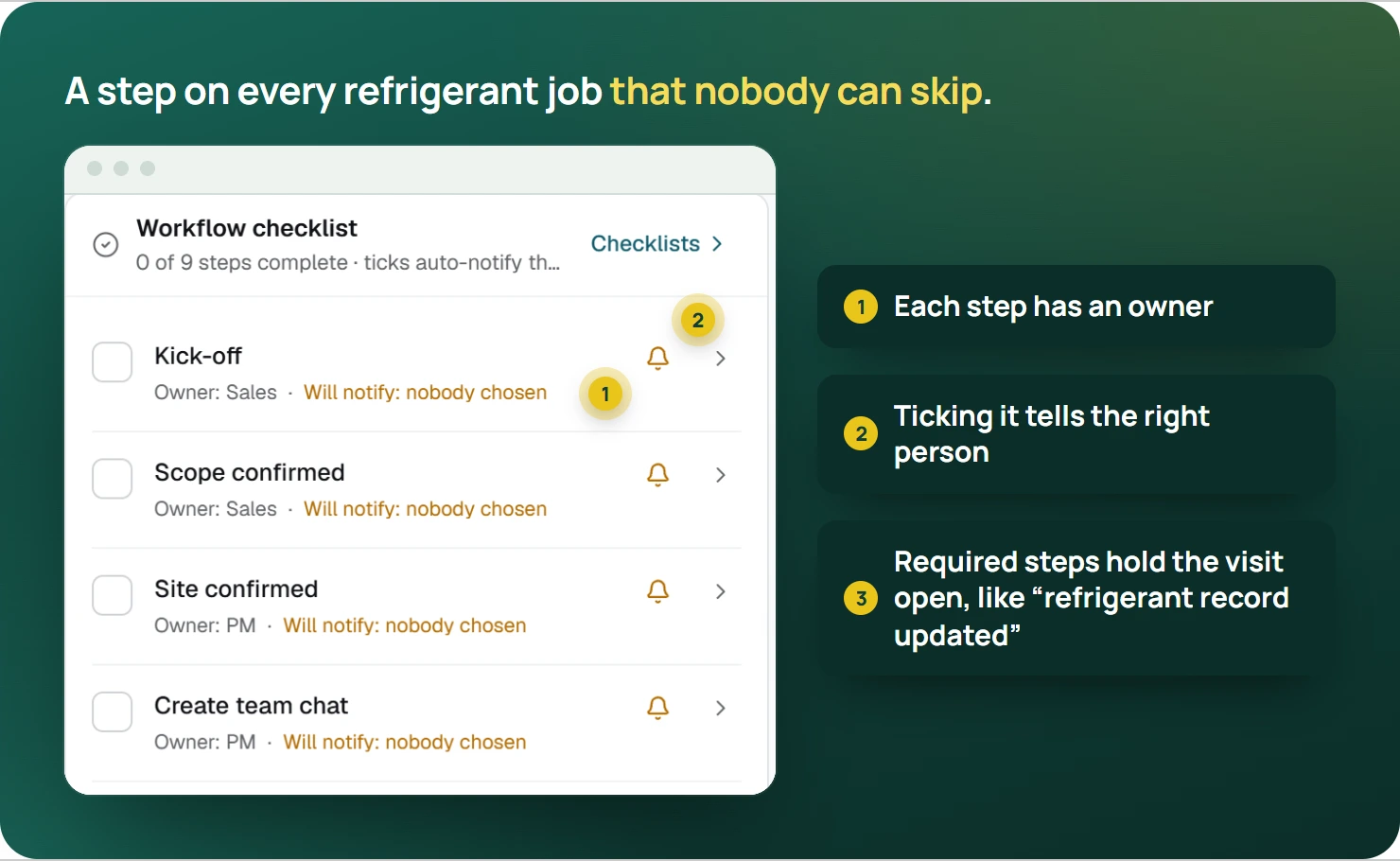
Our one honest limit: EasyDone doesn't keep your refrigerant register or report to ARC for you. That stays in the system your authorisation requires. EasyDone makes sure nobody forgets it.
Back in Clarkson, Kirsty doesn't open a single screen. She asks the Assistant, typed or spoken: "Quote the property manager for a fan motor on condenser S3 at the Currambine dental practice, our usual rates, and book Reuben back in once it's approved." It finds the customer and the site, uses her saved rates and defaults, asks for anything it can't find, and shows her the quote before anything goes. Money and customer sends always wait for her OK.7
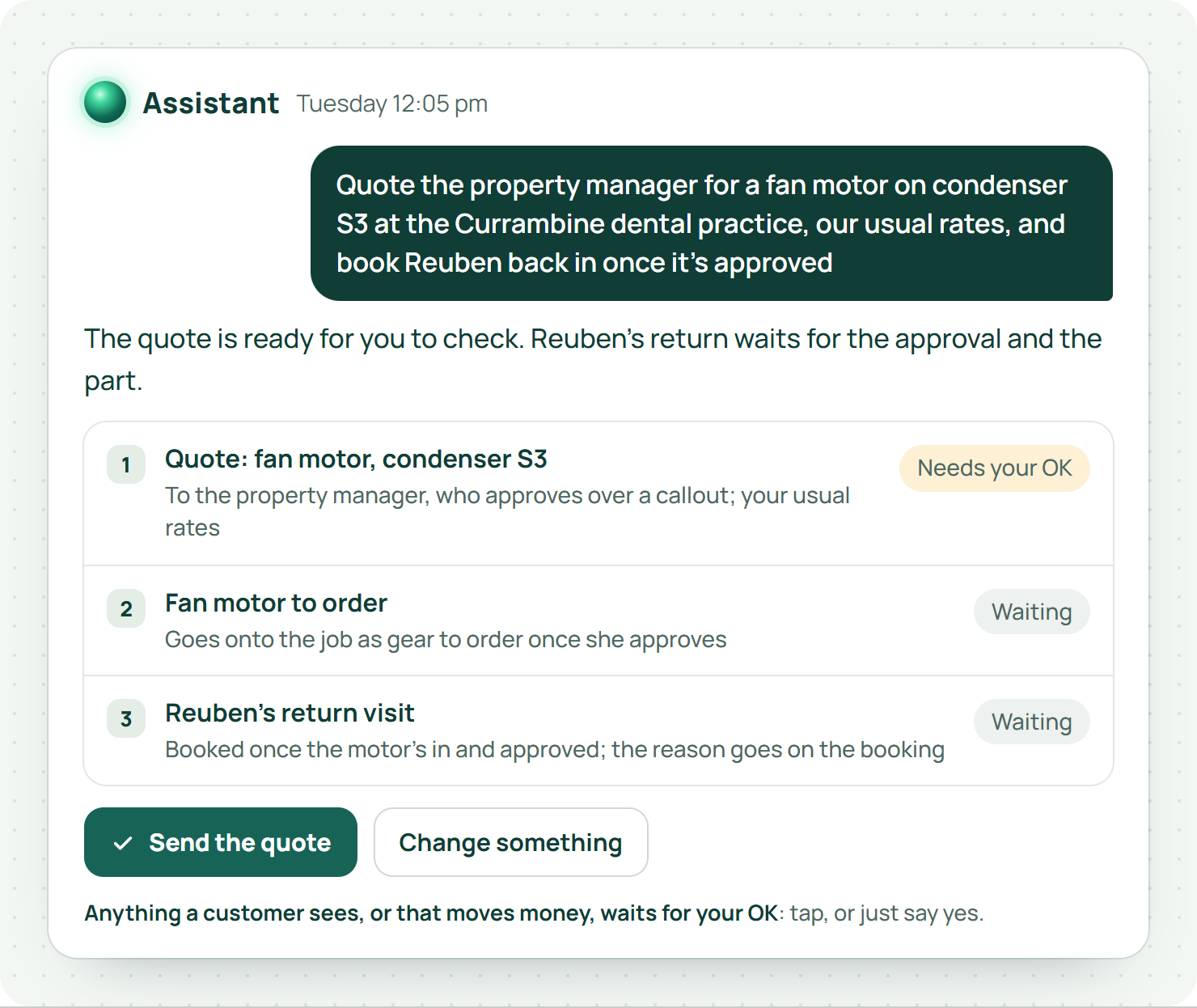
That's the difference with our Assistant. Most of the AI in trade software summarises the job for you. Ours does the admin, inside the permissions you give it, so the apprentice can log his hours but can't go sending quotes to property managers.7
The property manager approves. The fan motor flows onto the job as a part to order, gets ordered on a purchase order from the job, and when it arrives it's reserved for Currambine, so the bloke doing the Butler ducted install doesn't pinch it off the shelf.6 The return visit is booked with its reason on it: motor arrived, approved, roof key with the practice manager.
The practice is on a maintenance agreement now, too. Two services a year, with the renewal tracked, so Kirsty's office isn't relying on someone remembering in September.6 Invoices go out straight from the finished job, and overdue ones get a reminder without anyone having to chase.6
Back on the roof
The next Tuesday, at 10.40, Reuben climbs back up. He walks straight to S3, swaps the motor, and he's down in forty minutes with photos on the job and the refrigerant step ticked.
The dentist didn't lose an afternoon of patients. The property manager got a quote in her inbox before her meeting ended. And when the next tech goes up there next autumn, the labels are on the units and the history's on the job.
So where do you start?
Pick one commercial site with more than one system. Walk it, label every unit, photograph every data plate, and put it on the record. Then run the next visit through the six handovers above. If it works for a roof with four identical condensers, it'll work for everything.
Our service agreements guide covers the maintenance side, and the electrical playbook runs the same idea through a fit-out.
Then book a demo of EasyDone's field tools and bring the job that had your tech on a hot roof doing detective work. We'll run it from the first call to the return visit, before summer turns the phones up.