
Written by Colin Tross, founder of EasyDone and an audio visual installation business owner. Last checked 10 October 2026.
It's 7.40 on a Tuesday in Bassendean. Jo Rossiter's apprentice, Kai, is standing in the kitchen of a weatherboard rental with a wet towel in one hand and his phone in the other. The flexi hose under the sink has let go. The tenant is late for work, and on her way out the door she asks if he can "have a quick look at the hot water system while you're here, it's been making a noise."
The property manager who booked the job is in Joondalup and not picking up. The owner of the house is in Karratha on a swing. And Jo is back at the shed in Bassendean trying to get three more vans out before eight.
The plumbing is the easy bit. It's everything around the plumbing that eats a business alive.
What's really going on?
Jo isn't short on work. Rossiter & Daughter Plumbing has four plumbers, two apprentices and more rental maintenance than they can poke a stick at. What she's short on is one version of the truth.
On that one Tuesday job there are four people: the tenant who reported it, the property manager who approves it, the owner who pays for it, and Kai, the only one who actually saw it. If those four are working off four different stories, somebody gets a surprise invoice and somebody gets a cranky phone call. Usually Jo gets both.
Every plumbing job that goes sideways goes sideways at one of six handovers. Here's how to nail each one.
1. The first call: who's there, who's paying, who says yes?
Get the address, the person on site, the problem in the customer's own words, and the one everybody skips: who approves the money. On a rental, the tenant reports it, the property manager approves it and the owner pays. Three people, three phone numbers. Get all three before the van leaves.
Then put what you're coming to do, and how you charge for it, in writing. WA Consumer Protection recommends getting the work and the costs written down,1 and it's a lot cheaper than arguing about a callout fee three weeks later.
2. Before the van leaves: is the job actually ready?
An inspection, an agreed replacement and a return trip with a part are three different jobs, so book them as three different jobs. If the part isn't on the van, or nobody can let you in, the job isn't ready, whatever the calendar says. A booking that hides a missing part is just a wasted drive up Tonkin Highway.
3. On site: write it so the next plumber can pick it up
Note what you found, what you did, what you used and what's still open. "Can't get to the laundry trap, tiled over the access, PM to arrange" is gold. "Done" is useless. Photos beat paragraphs every time.
And keep the diagnosis with the person qualified to make it. Nobody in the office should be guessing what failed, and neither should any software.
4. The extra: "while you're here"
The tenant asking about the hot water unit is a request. It isn't approval, and she isn't the one paying. Record it separately from the job you were sent for, price it, and send it to the person who can say yes. Meanwhile the flexi hose job gets finished and closed off on its own, so it doesn't sit open for a fortnight waiting on someone else's decision.
5. The paperwork the state wants
Building and Energy spells out which plumbing work needs a notice and which needs certifying,2 and the licensed plumber lodges those through plumbing eNotice.3 Backflow testing has its own lodgement, through the Water Corporation's backflow reporting system.4
Give each one an owner, and a tick on the job when it's actually been lodged, with the reference number next to it. "I'm pretty sure Davo did it" is not a filing system.
6. Invoice it or book the return, and say why
The office should be able to see at a glance what was approved and done, what was asked about but not approved, and what still needs a second visit. Business.gov.au says a proper invoice clearly describes the work,5 so describe it the way it happened.
Every return visit needs three things on it: why it's needed, what has to happen first, and who's sorting it. Then the next plumber doesn't have to rediscover the problem from scratch.
How Jo runs that Tuesday in EasyDone
Yeah, we make EasyDone, so we're biased. Here's why we reckon it was built for exactly this kind of morning.
The property manager's request lands as an enquiry and gets attached to the right customer. One property manager, a whole stack of sites under them, and every site with its own history, so Kai can see that the same house had a blocked stormwater drain last winter. Tenant, property manager and owner all sit on the record as contacts, so nobody rings the wrong one.6
Jo books the job against who's actually free. Kai opens Today on his phone and sees the job, the access notes and the On my way button. The text to the tenant is previewed before it goes, so there's no "the plumber's coming at some point" guesswork.6
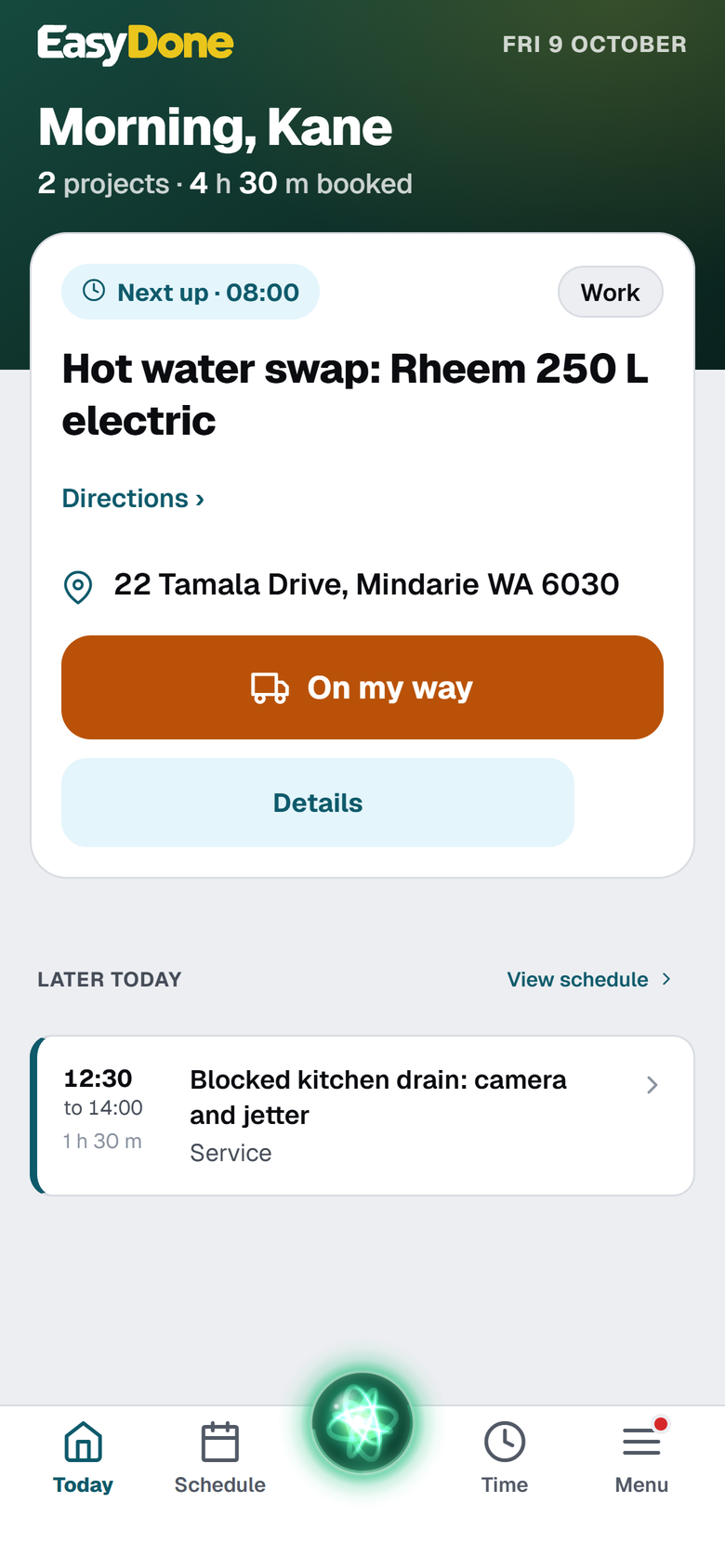
On site, time runs against the job, and Kai's notes, photos and the parts he used go straight onto it while they're still fresh. The hot water noise gets its own note and a follow-up, separate from the flexi hose, exactly like the playbook says.6
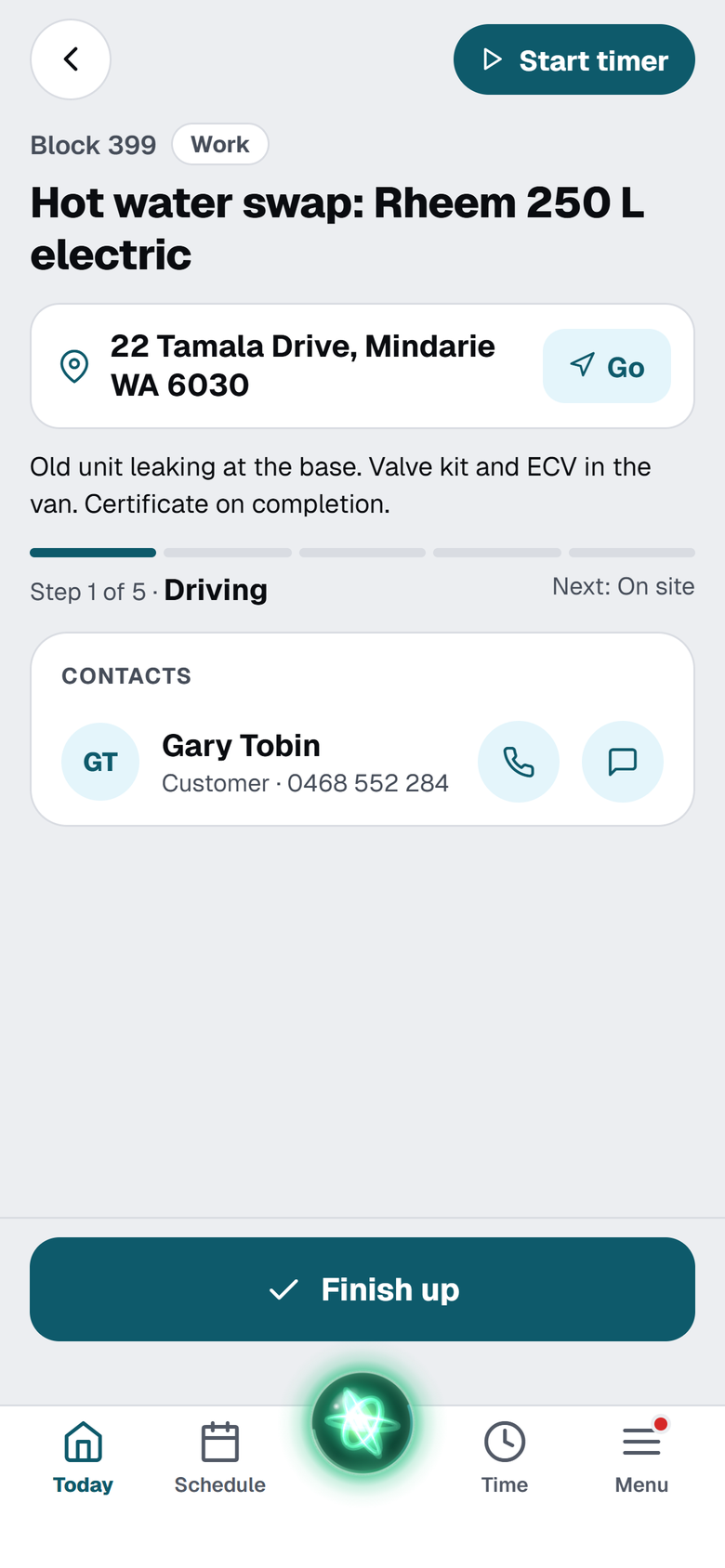
Back at the shed, Jo doesn't open a single screen. She asks the Assistant: "Quote the hot water replacement at the Bassendean rental for the property manager, our usual rates, with a heat pump as an option." It finds the customer and the site, uses her saved rates and defaults, asks for anything it can't find, and shows her the quote before anything goes anywhere. Money and customer sends always wait for her OK.7
The property manager says yes to the heat pump. The won quote becomes the job, and the unit and fittings flow onto it as gear still to order. Jo raises the purchase order from the job, and when the unit comes in it's reserved for that job, so the bloke doing the Guildford renovation doesn't quietly pinch it off the shelf.6
For the paperwork, Jo has a required checklist step on the hot water job: lodged, with the reference. Kai can't close off the visit until it's filled in.6 Our one honest limit: EasyDone doesn't lodge anything with Building and Energy for you. The eNotice itself still happens in the government's system, and EasyDone makes sure nobody forgets it did.
Then the flexi hose job goes out as an invoice straight from the finished job, described the way Kai recorded it, and if the property manager sits on it, the overdue reminder goes out without Jo having to remember to chase.6
Back to Bassendean
By half past four, Jo is on Reid Highway heading home. The flexi hose is invoiced. The heat pump quote is approved, the unit's on order, and the return visit is booked for Thursday with a note that says why, what's coming and who's letting them in. The owner in Karratha got the quote through the property manager without anyone ringing him at the mine site.
Nobody rang Kai at lunch to ask what he found. It was already on the job.
So where do you start?
Pick your messiest rental job from last month: the one with the tenant, the property manager, the owner and the "while you're here". That's the one to fix first, because if it works for that, it works for everything else.
The HVAC playbook runs the same idea through an equipment service business. And if you want to see that Bassendean Tuesday on screen, book a demo of EasyDone's field tools and bring your own job. We'll run it from the first call to the invoice, and you'll be home before the Reid Highway traffic.