
Written by Colin Tross, founder of EasyDone and an audio visual installation business owner. Last checked 10 October 2026.
It's 6.50 on a Wednesday in Osborne Park, second floor of an office fit-out that smells like fresh plasterboard. Dev Sandhu has a test sheet on a clipboard, a coffee on the window sill and a shutdown window that starts at seven and ends at nine, because the building manager said so and the building manager means it.
At 6.52 the tenant's office manager wanders in with a lanyard and a list. "While you're here, can we get three more double power points in the kitchen? And the lights in the boardroom flicker. Is that you lot?"
Back at the shed in Wangara, Gemma Rennick is getting four more vans out the gate. She doesn't know about the power points yet. She doesn't know about the flicker. She'll find out at 4.30, by phone, from the Mitchell Freeway, if she's lucky.
The wiring is the easy bit. It's the stuff around the wiring that gets a sparky business in strife.
What's really going on?
Rennick Electrical has five sparkies, two apprentices and a good mix of work: commercial fit-outs, strata maintenance and a steady run of switchboard upgrades in the northern suburbs. Gemma isn't short of work. She's short of one clear story per job.
On that Osborne Park morning there are five people with a stake: the builder who booked it, the building manager who controls the shutdown, the tenant who wants extras, Dev who's actually there, and Gemma, who has to invoice it. Plus one more nobody sees: whoever lands the job next month and has to work out what Dev did.
Electrical jobs go sideways at six handovers. Get these right and most of the 4.30 phone calls disappear.
1. What should the booking tell the sparky?
Everything they need to start without ringing anyone. The site, who's on site, what's actually been approved, the access arrangements, and who can say yes to a change. Not "electrical job, Osborne Park". That's not a booking, that's a riddle.
Two names matter more than the rest. The person who controls the work area (here, the building manager and his shutdown window) and the person who can approve money (the builder, not the tenant with the lanyard). Write both on the job before the van leaves.
Keep the customer's words as their words. "Boardroom lights flicker" goes on the job as a reported issue. It's not a diagnosis, and nobody in the office should turn it into one. The bloke with the meter decides what it is.
2. Is the crew lined up with the site?
A booking is a plan. The site is the truth. Before you confirm a visit, check the people, the access and the prep actually line up: is the shutdown agreed, is the ceiling open, is the other trade who has to be there actually booked?
Safe Work Australia puts a lot of weight on duty holders consulting and coordinating with each other.1 On a shared commercial site that's the builder, the building manager and you, and it works a lot better when the arrangement is written on the job and not in a text thread on one phone.
Here's a habit that pays for itself: every afternoon, the office looks at tomorrow's exceptions. Access not confirmed. Required person not available. Scope decision still open. Sort those three lists before anyone calls the diary finished. A van that rolls up to a locked plant room is the most expensive cup of coffee in Perth.
3. What belongs in the field record?
What you did, what you found, what you used, and what's still open. Keep those four separate. "Replaced two faulty downlights in boardroom, fault found in driver, remaining six on same circuit untested, recommend replacing" is gold. "Done" is useless.
Photos beat paragraphs. A shot of the board before and after, the label you put on the new circuit, the cable route through the ceiling space. Next month's sparky will thank you, and so will you when the builder asks what was there before.
And be dead straight about boundaries. If you tested half the installation, the record says half. A tidy report that suggests the whole floor passed when it didn't is worse than no report at all.
4. "While you're here": how do you handle the extras?
The office manager's list is a request. It isn't approval, and she isn't the one paying. Record the three extra GPOs and the boardroom flicker as their own items, separate from the job Dev was sent for. Price them. Send the price to the person who can say yes, which on a fit-out is usually the builder.
Meanwhile the original scope gets finished and closed off on its own, so it doesn't sit open for a month waiting on someone else's decision.
WA Consumer Protection recommends getting the work and the costs in writing.2 On a variation it's also how you get paid for it. "The tenant asked" isn't an approval. "Approved by the site manager, quote attached" is.
5. How should certificates and notices be tracked?
As their own job item, with a name on it and evidence it's done. Never as "the job's closed, so it must be done".
WA's electrical eNotice puts the responsibility on the electrical contractor to certify the work is complete, safe and compliant,3 and Building and Energy's technical guidance sets out which notification and certification duties apply to which work.4 The licensed person decides what applies. The office's job is to make sure it doesn't fall through the cracks.
The fix is simple. Two different statuses: "site work done, notice still to lodge" and "notice lodged, reference number here". Those words let anyone in the business pick up the job without guessing.
6. What do payroll and the office actually need?
Real hours and a clear outcome. The schedule said Dev would be there four hours. He was there five and a half, because the shutdown ran late. Payroll needs the five and a half, not the plan.
Fair Work is clear that which award applies depends on the industry and the work someone does,5 so whoever does the pays makes that call. The job record is what they work from, so make it accurate.
And the commercial handover is three lines: is the approved work done, is an extra waiting on approval, and is another visit needed? Then a name against the next step. If the office has to ring Dev for the story, the record didn't do its job.
How Gemma runs that Wednesday in EasyDone
Yeah, we make EasyDone, so we're biased. Here's why we reckon it was built for exactly this kind of morning.
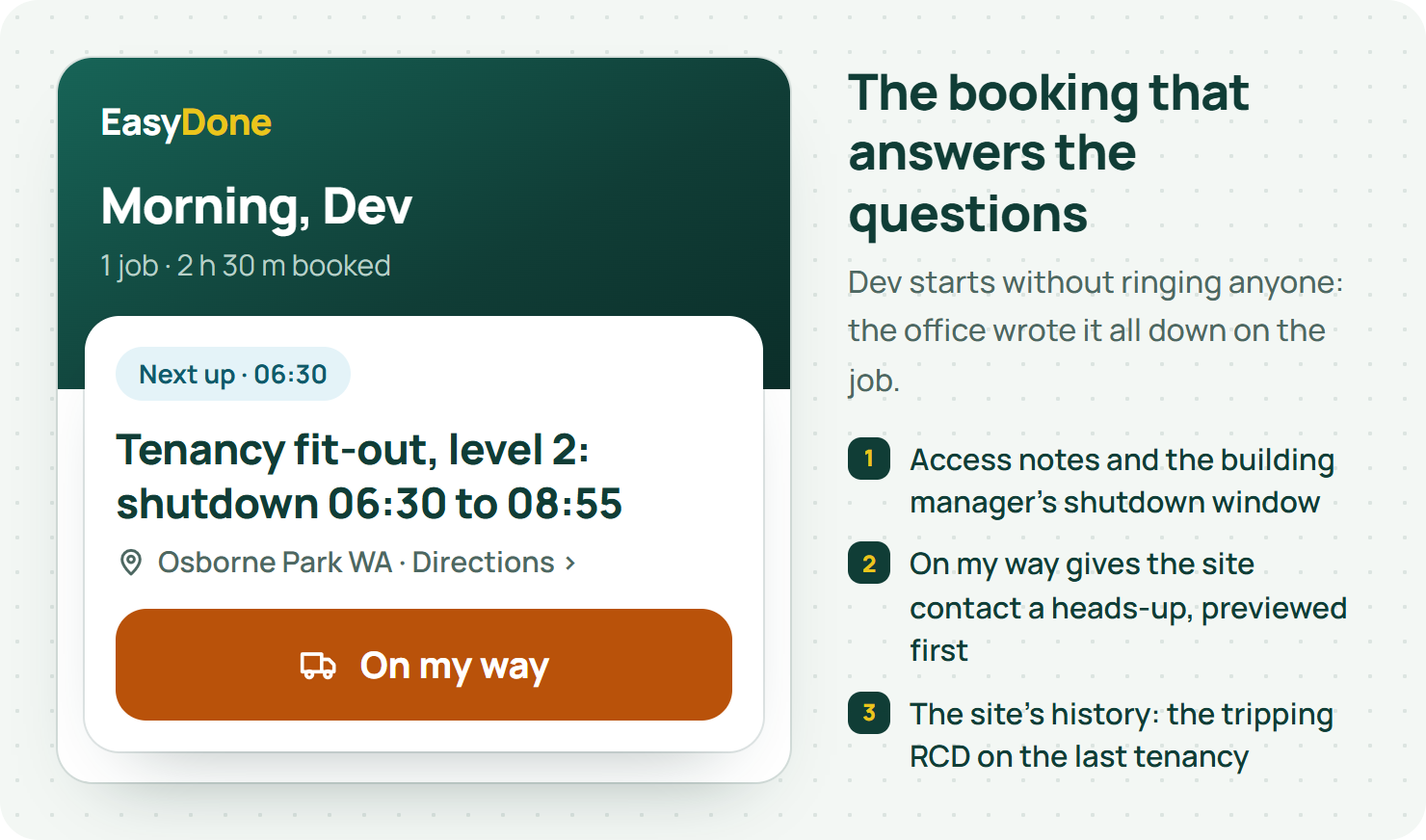
The builder's request lands on the right customer, and the Osborne Park site sits under the builder with its own history, so Dev can see that the same floor had a tripping RCD on the last tenancy. The building manager and the tenant's office manager sit on the site as contacts, so nobody rings the wrong one.6
Dev opens Today on his phone and sees the job, the access notes and the shutdown window the office wrote down. On my way sends the site contact a heads-up, previewed before it goes.6
On site, time runs against the job. Dev's notes, photos and the parts he used go on it while they're still fresh, and the boardroom flicker gets its own note and follow-up, separate from the fit-out scope, exactly like the playbook says. Gemma has a required checklist step on the job: "notice lodged, reference recorded". The visit can't be closed off until someone fills it in.6
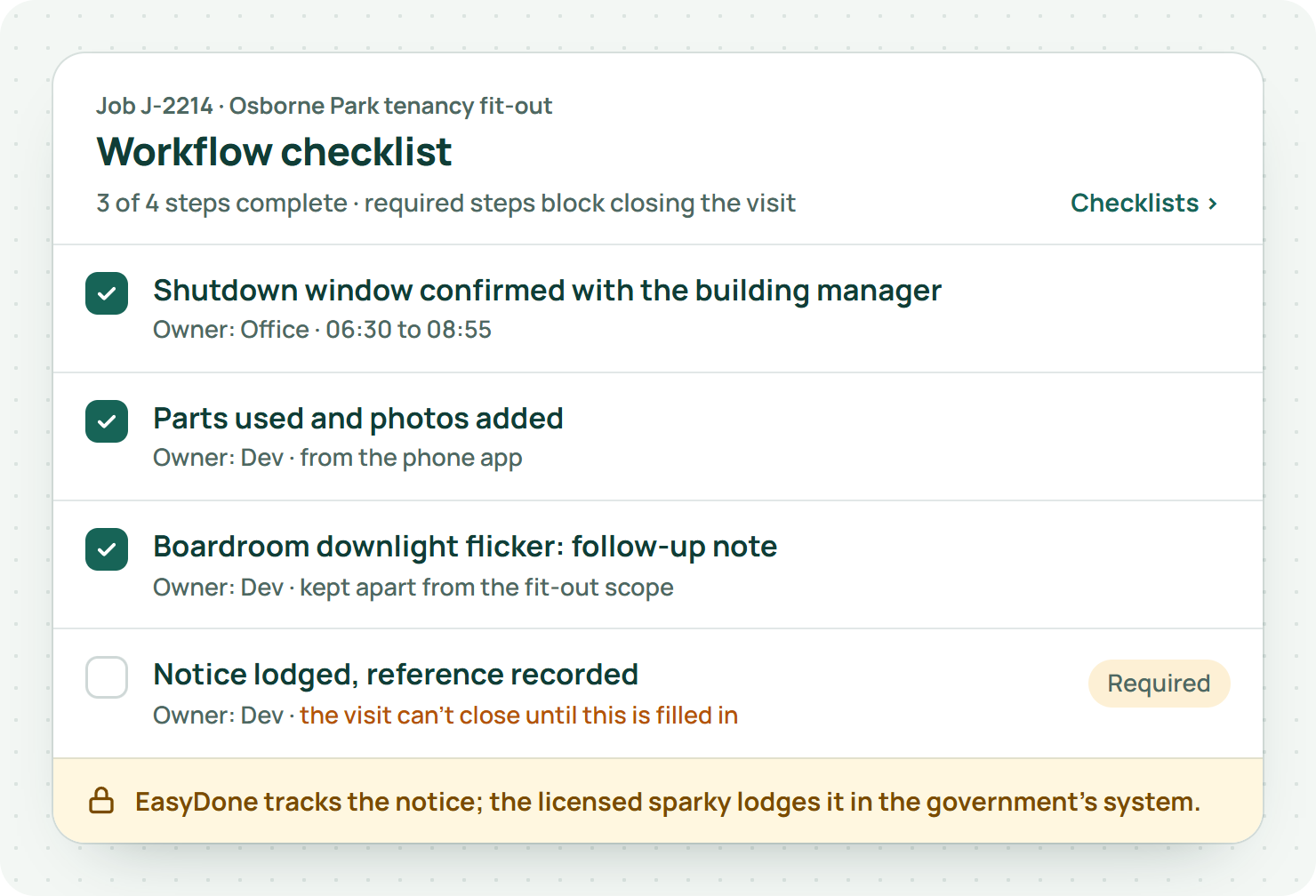
Our one honest limit, and it's an important one: EasyDone doesn't lodge your eNotice or certify anything. The licensed sparky does that in the government's system. EasyDone makes sure nobody forgets it happened, and keeps the reference with the job.
Back at the shed, Gemma doesn't open a single screen. She asks the Assistant, typed or spoken: "Quote the builder for three extra double GPOs in the Osborne Park kitchen at our usual rates, and add an option to replace the six boardroom downlights." It finds the customer and the site, uses her saved rates and defaults, asks for anything it can't find, and shows her the quote before anything goes anywhere. Money and customer sends always wait for her OK.7
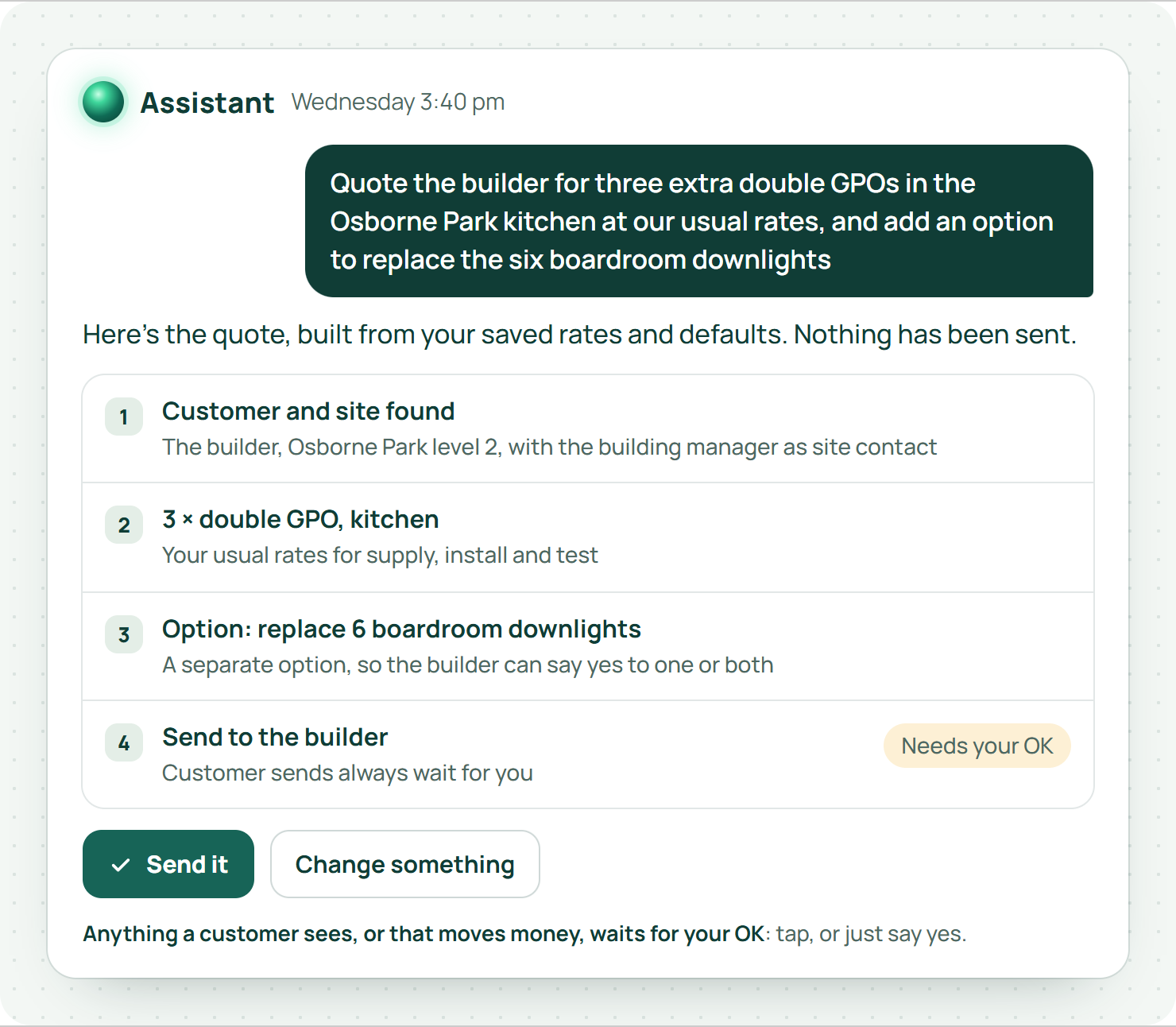
That's the bit the other job apps don't do. Most of the "AI" out there will summarise a job for you. Ours does the admin, inside the permissions you give it, so the apprentice can ask it to log his hours but can't go sending quotes to builders.7
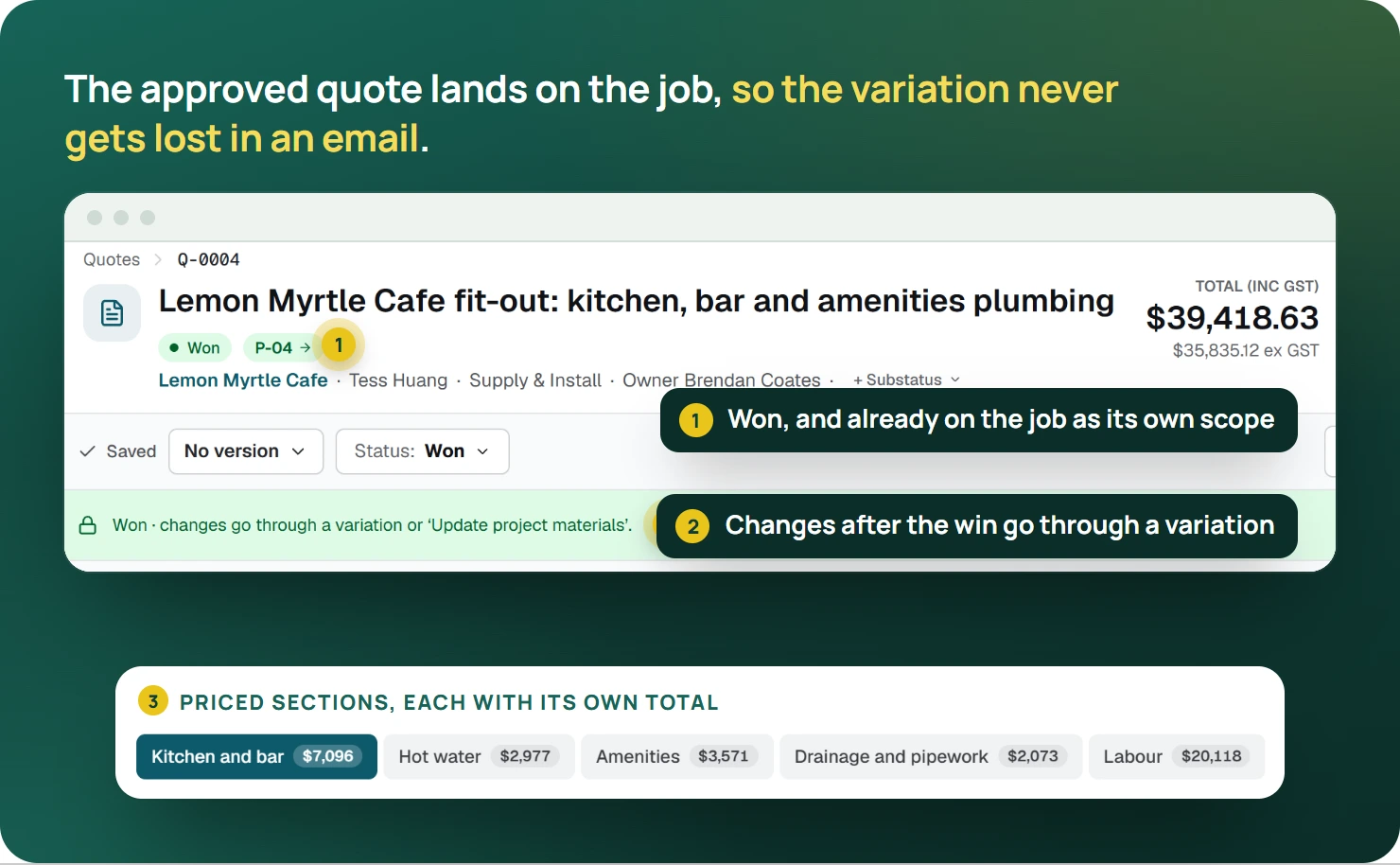
The builder approves both. The won quote lands on the job as its own scope, with its own lines and labour budget, so the variation never gets lost in an email. The downlights flow onto the job as gear to order, and when they arrive they're reserved for Osborne Park, so the strata job in Joondalup doesn't quietly pinch them off the shelf.6
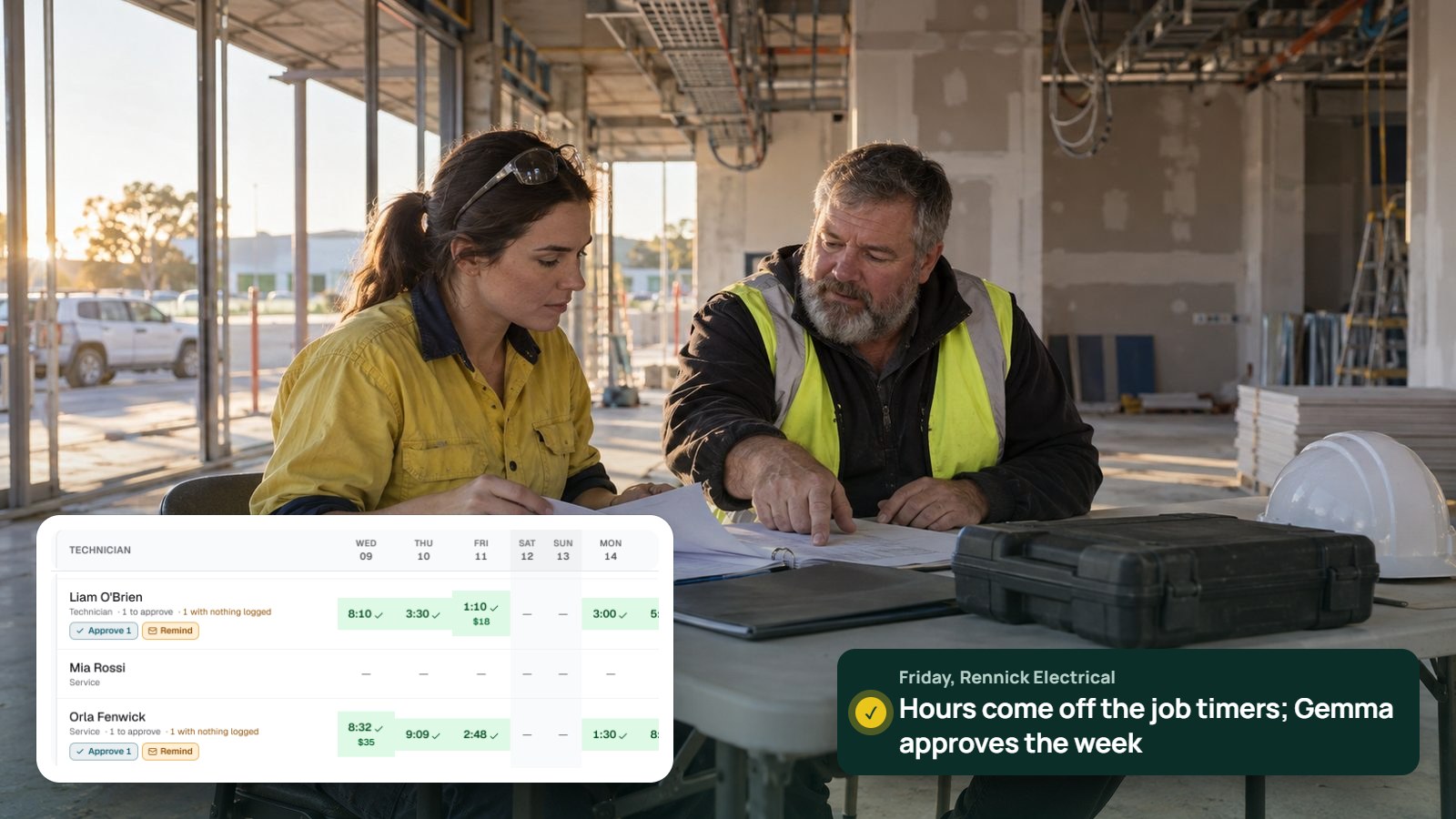
Friday, Dev's hours come off the job timers into his timesheet. Gemma reviews and approves the week, and the late shutdown is right there in the record, so nobody's arguing about an hour and a half.6 The fit-out invoice goes out straight from the finished job, described the way Dev recorded it, and if the builder sits on it, the overdue reminder goes out without Gemma having to remember to chase.6
And when something about the way Rennick works doesn't fit, say Gemma wants the shutdown window as its own field on every commercial job, she asks for the change and Workshop builds it for her business.6
Back to Osborne Park
At 4.30 Gemma's on the Mitchell Freeway and her phone doesn't ring. The fit-out scope is finished and invoiced. The extra GPOs are approved, quoted and booked for next Tuesday's shutdown. The boardroom downlights are on order with Dev's photos of the failed driver attached. The notice is lodged and the reference is on the job.
The building manager got his floor back at 8.55. The office manager got her power points. And nobody rang Dev at lunch to ask what he found.
So where do you start?
Pick your messiest commercial job from last month: the one with the shutdown, the tenant, the builder and the "while you're here". Run it through the six handovers above and see where it leaked. That's the one to fix first.
Our invoicing guide for Perth electricians picks up where this leaves off, and the plumbing playbook runs the same idea through a rental maintenance business.
If you want to see Gemma's Wednesday on screen, book a demo of EasyDone's field tools and bring your own job. We'll run it from the booking to the reference number, and you'll be home before the freeway clogs up.