
Written by Colin Tross, founder of EasyDone and an audio visual installation business owner. Last checked 10 October 2026.
It's 8.45 on a Sunday night in Henderson and Leanne Szabo has a developer's quote open on the laptop and a glass of red she hasn't touched. The quote has six figures on it. It's for an app to run Szabo Scaffolding: hire jobs, erect and dismantle crews, every coupler and plank out on every site, and the weekly hire invoice that currently takes her all of Monday.
The number isn't what's bugging her. She half expected it. What's bugging her is the line at the bottom: "hosting, support and changes quoted separately".
Separately from what? For how long? And what happens in year three?
What's really going on?
Szabo Scaffolding has twenty-odd people, a yard full of steel in Henderson and a lot of work on commercial jobs and the Kwinana industrial strip. Leanne's run it on a spreadsheet, a whiteboard and a generic job app for six years. She's right that it doesn't fit. Scaffold hire really is different: the gear goes out, sits on site for weeks, gets added to and partly struck, and is charged by the week.
So custom software isn't a crazy idea. But a developer's quote is only one jar on the shelf. There are five, and most businesses only look in one.
The five jars
Here's the whole budget, start to finish:
- Discovery. Mapping how you actually work, checking the old data, proving the tricky connections, and agreeing what "done" means.
- The build. Design, development, testing, moving your data across and training the crew.
- Running costs. Hosting, storage, text messages, monitoring, support, fixes and updates, every year, for as long as you use it.
- Your own people's time. The yard manager in workshops, the bookkeeper checking balances after the move, a leading hand testing the phone app. That's real time not spent on paid work.
- The exit. Overlapping subscriptions while you switch, archives of the old system, and one day, moving off this one too.
Business.gov.au makes a useful distinction between a budget, which is what you plan to spend, and a forecast, which is what current information says you'll actually spend.1 Do both. A project can come in on its total and still wreck a month's cash flow because a payment milestone moved.
Ask every supplier for payment dates, not just totals. And make them show any "provisional" amounts in plain sight, with a name against who firms each one up.
What do Perth developers actually publish?
Not much, and they all do it differently. Here's what three local firms said on their own sites when we checked on 10 October 2026:
| Supplier | How they explain cost | What you still need in writing |
|---|---|---|
| Hatchet | Typical builds from $20,000 to $120,000-plus excluding GST, scoped in a design phase, with hosting and support quoted separately. (Hatchet, Software development Perth, read 10 October 2026) | Your design stage, the actual build, hosting and ongoing support. |
| PWD | Scoping, then a fixed-fee discovery sprint, then an estimate; it names integrations, user roles, migration and undecided processes as cost drivers. (PWD, Custom software development, read 10 October 2026) | Roles, connections, moving your data, security and anything still undecided. |
| HELLO PEOPLE | Fixed project pricing after discovery, delivered in stages. (HELLO PEOPLE, Software development Perth, read 10 October 2026) | The agreed scope, how each stage is accepted, and how changes are handled. |
That's three suppliers, not a Perth average, so don't treat it as one. A fixed price is only as good as the list of what's in it. A quote for a prototype isn't comparable with one for a working system with data migration, training and support.
The trick: give every supplier the same list of what you need, and ask them to mark each line "included", "excluded" or "provisional". Then you're comparing apples with apples.
Which bits are hardest to price?
The ones nobody can show the developer yet.
Take Leanne's hire invoicing. Sounds simple: charge each site weekly for the gear on it. Then the questions start. What if half the scaffold is struck mid-week? What if gear moves from one site to another without coming back to the yard? What if the builder disputes a week? Which system owns the customer record, the app or Xero?
Every one of those answers can double or halve a chunk of the work. PWD lists exactly these kinds of things, integrations, roles, migration and undecided processes, as what drives cost, (PWD, Custom software development) and they're right.
So before you ask for a final number, collect five or six real, de-identified examples of the awkward cases, each with what should happen. A developer can price "this partial strike on this site" much better than "it must handle everything".
And it's fair to pay for discovery on its own. A good discovery that tells you not to build is money well spent.
When does shaping a platform cost less?
When the platform already does the boring, expensive bits, and the stuff that's genuinely yours is a short list.
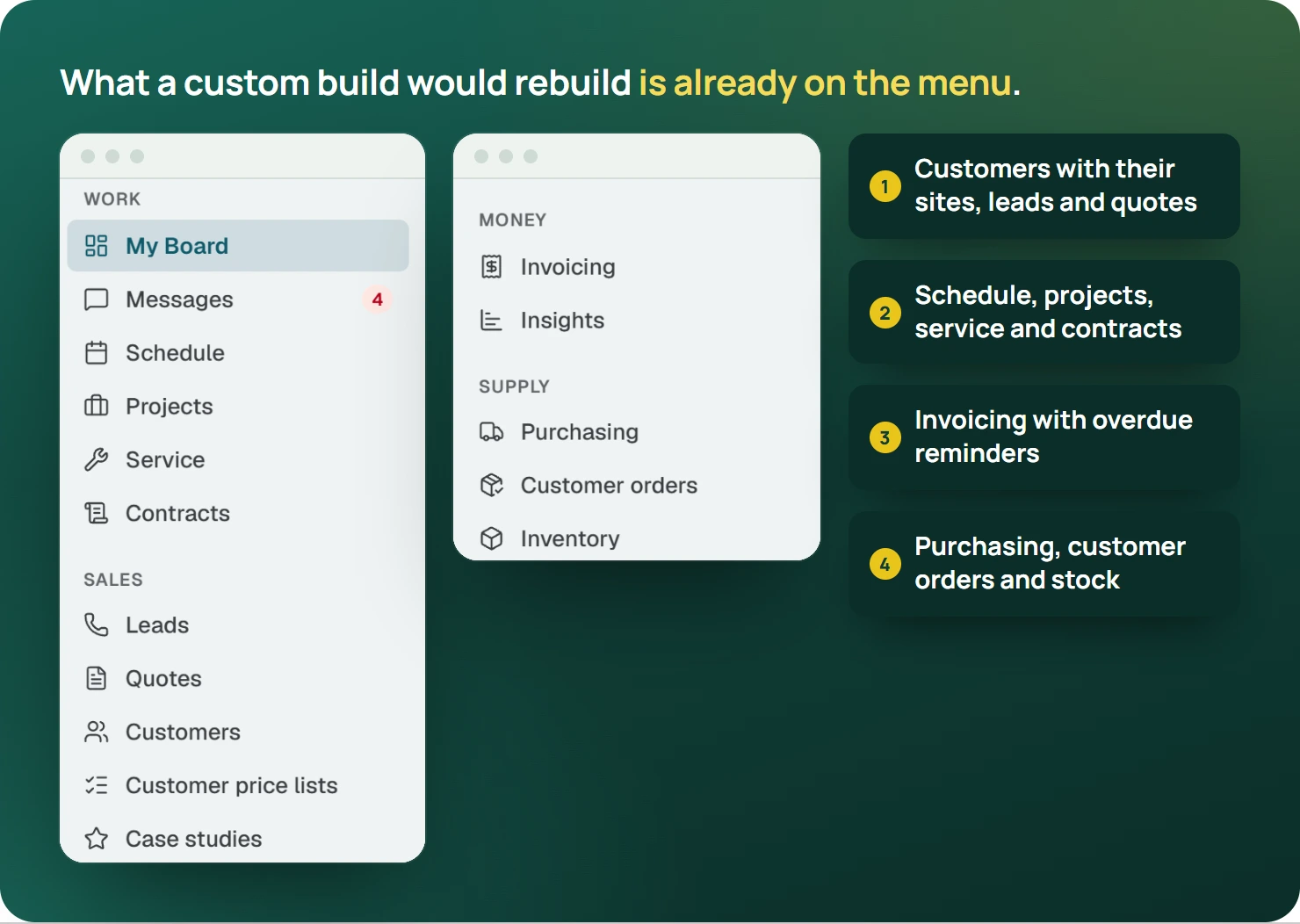
Here's the thing most custom quotes quietly include: rebuilding what every trade business already needs. Customers and their sites. Quotes. Bookings. A crew phone app. Timesheets. Invoicing and reminders. Permissions. Backups. That's a big slice of the build jar, spent on things that already exist and already work.
So compare like with like, over the same period, say three years:
- The custom build: discovery, build, running costs, your team's time and the exit.
- The platform: the subscription for your team size, the specific changes you need, your team's time and the exit.
Don't compare the custom build's first-year invoice with one month of a subscription. That's how people talk themselves into the wrong thing in both directions.
How do you work out the value without kidding yourself?
Measure one painful job before you change anything. For Leanne, it's Monday's hire invoicing. Time it. Count the corrections. Count the invoices that went out late.
Then run the same job in the proposed system, with comparable records, and measure again.
If it saves six hours a week, decide what that's actually worth. Less overtime, invoices out on Monday instead of Wednesday, or Leanne home for dinner. Those are different benefits. Don't count all three against the same six hours.
And count the new work, too. A connection that saves typing but needs reconciling every Friday is still a cost. Write the case without the hoped-for growth. If it only adds up with optimistic numbers, shrink the first stage.
What has to be settled before the deposit?
Who owns it, what "done" means, and who fixes it when it breaks.
IP Australia explains that intellectual property created by a contractor generally stays with the contractor unless the contract says otherwise.5 Paying the invoice doesn't make the code yours. Get the agreement checked for the rights you need, including getting someone else to maintain it later.
Tie each payment to something you can check. A demo that works on the developer's laptop isn't the same as a release your crew can use on site.
Where does EasyDone fit?
Yeah, we make EasyDone, so we're biased. Here's why we reckon it belongs in Leanne's comparison.
EasyDone already does the boring bits: enquiries, quotes, customers with all their sites, scheduling, the phone app with Today and On my way, time against the job, checklists, projects with scopes and progress claims, stock with transfers and stocktakes, purchase orders, and invoicing with overdue reminders.6 None of that goes in the build jar.
The genuinely scaffold-shaped part, weekly hire charging for gear out on site, partial strikes, transfers between sites, is what Workshop is for. You ask for the change in plain words, it gets planned, built and tested, and you review it before it's yours.7 Our one honest limit: Workshop is ongoing development, and not every request gets accepted exactly as asked. Sometimes you get a better idea back. But you're not paying to rebuild invoicing to get there.
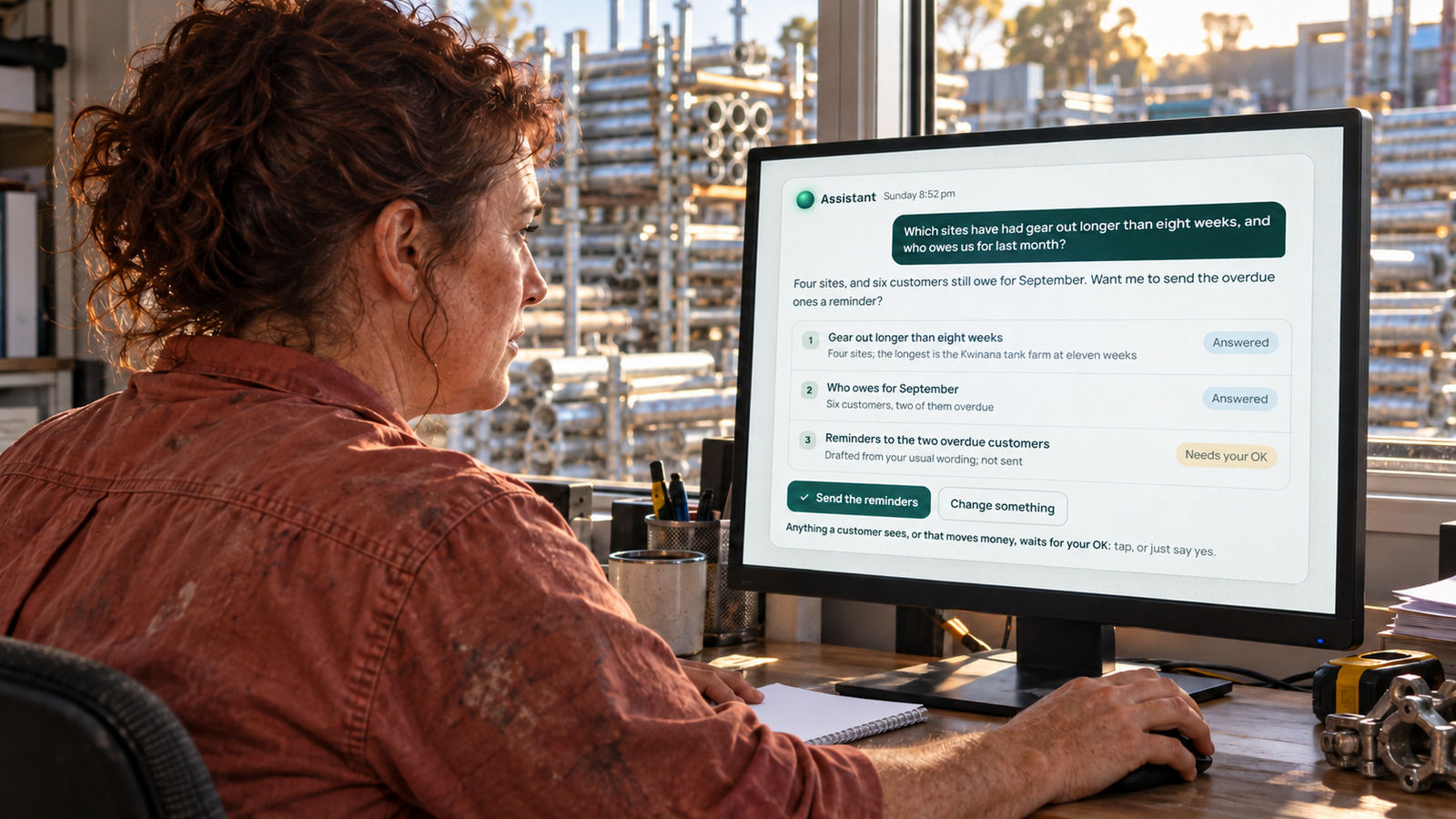
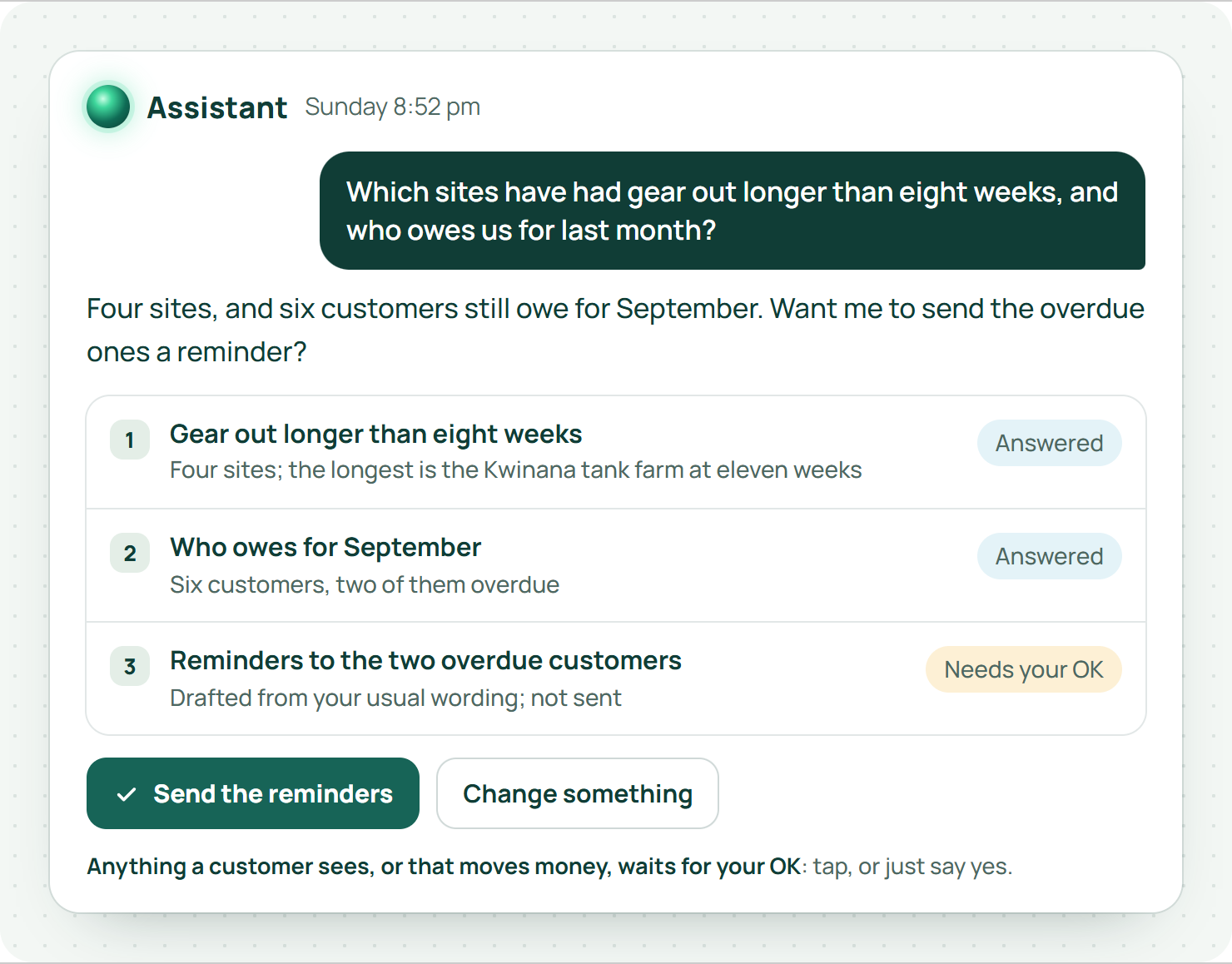
And the admin gets done for you along the way. Leanne can ask the Assistant: "Which sites have had gear out longer than eight weeks, and who owes us for last month?" It answers from her records, and when she asks it to send the reminders, it waits for her OK.8
Our pricing is on the pricing page, in plain numbers, so you can put it straight into the platform column.
Back in Henderson
Leanne put the five jars into a spreadsheet, which felt about right for a Sunday night. The developer's quote filled the build jar nicely. The running costs jar had a question mark in it. The exit jar was empty, because nobody had asked.
Then she drew a line through every part of the build that was really just customers, quotes, bookings, timesheets and invoicing. About two thirds of it. What was left was the hire charging, and that's what she took to the next meeting.
The red got drunk. It was a good Sunday after all.
So where do you start?
Draw the five jars on a sheet of paper and fill in what you know. Then circle the one job in your business that's genuinely unlike anyone else's. That's the bit worth paying to build.
Our Perth custom software guide covers when each route makes sense. And if you want to see how much of your list already exists, book an EasyDone demo and bring your developer's quote. We'll go through it line by line.